Category Archives: Health and Healing

On self-isolation, asking for support, kitty snuggles, and mental health in the rough moments

Sometimes I get in my own way. I don’t ask for what I need. I feel that I need to tough out situations on my own. I don’t want to bother anyone. All are my mistakes. Writing my last post about sadness as I heal from injury was really difficult for me and some thing I needed to do for several weeks. I don’t like to inconvenience people. I don’t like to make waves. I’m more comfortable with people offering help than asking for it.

What I realized was that my strategy was one of self isolation which exacerbated the feelings of helplessness, loneliness, sadness, frustration, boredom, and depression I was already feeling.

Kitty snuggles always help!

My thinking went something like. “This is a rough time of year for many people. So much loss. So much pain. Do I really need to add to that for anyone?” Or “This is such a special, happy, joyous time for many people. Do I really need to bring them down with my concerns?” Or “Other people are so much worse off than I am. Do I really have a right to complain?” There are fallacies in all 3 of these views that responses from family and friends after reading my last blog helped my articulate.

The first fallacy is about not wanting to make someone else’s situation harder. The reality is that when we share our sorrows we feel understood and seen. We reaffirm important connections; we allow people to share their moments as well – reciprocal disclosure and all that. When we share the load, it’s much lighter for everyone.

The second fallacy – bringing people down when they’re up is equally misguided. People like to show care. Compassion and helping someone in a time of need helps us feel good about ourselves. Side note: Crying is cathartic. Crying with someone else, even moreso. And after someone has heard our pain, our loss, our sadness, the joy in their lives will be there for them to return to.

In many ways, the third message is the most insidious. It leads both to guilt and to undervaluing our own experiences. Repeat after me: “My troubles are not in competition with anyone else’s. Comparison separates rather then unites us. My feelings, my emotions, and experiences are valid. I am worthy of compassion.”

Perhaps, most importantly, no matter how much they love you, no one can read your mind. If you can’t express your needs, they are less likely to be met. So, reach out. Phone a friend or family member. Ask for the support you need. Ask! You may be surprised who responds, and how much better you feel.

If you don’t feel comfortable reaching out to someone you know, call a crisis center near you or call 988. It’s a free call to help you get support with mental health issues. Similar to 911, 988 is dedicated to anyone in need of mental health assistance.

If someone hasn’t told you lately, you are important. You matter. The world is a better place because of the gifts you bring to it. You are precious. You are unique. You are loved. Happy holidays!

I Hope You Dance! I Will!

Dance has permeated my life. Even before I went to my first ballet class when I was 5, I loved to dance. I still do. My favorite emoji is the dancing woman.💃💃💃 I use it regularly to express joy. I guess that sums it up. For me, dance is joy.

My children inherited their passion for dance from me, and while they far exceeded my abilities as a dancer, they grew up dancing with me. From standing on my feet while I waltzed them around the room to a fusion of swing, jitterbug, and disco that we did to anything with a beat, joy with my children has always included dance.

When we came home from my second Fulbright trip to Russia in the summer of 2001, Alyssa and I were so wound up we couldn’t sleep, so we danced around the family room to Safri Duo’s – The Bongo Song

and Culture Beat’s – Crying in the Rain – which we fell in love with during my first Fulbright in Russia.

We spent over an hour laughing and spinning until we were finally tired enough to go to sleep at about 4 am. Alyssa was 8.

Our last song that night was from our first train trip from Moscow to Kazan, Robert Miles – Children https://youtu.be/z9b09Ljnh0k

While dancing gives me joy, watching my children dance feeds my soul. Dance metaphors have filled my children’s lives and my own. Both were competitive dancers for years and nothing gave me greater joy than watching them dance.

I wanted to sing Lee Ann Womack’s – I Hope You Dance to them in honor of their high school graduations, but I knew I’d never get through it. In addition to being a dancer, I’m a crier. I cry when I’m happy; I cry when I’m sad; I cry when I’m frustrated; I cry when I find something touching. I particularly get choked up by the lines “Whenever one door closes, I hope one more opens… When you get a choice to sit it out or dance, I hope you dance!” I want my children to live their lives dancing.

Lee Ann Womack – I Hope You Dance

As most of you know if you’ve read earlier posts, I’m going through a rough moment. I had surgery for a partially detached retina and my right leg is in a brace and I’m using crutches until I can get my knee checked out once the gas bubble in my eye dissipates. I heard this song the other day, and as she often does, Pink nailed it! “One thing I’m never going to do is throw away my dancing shoes… We’ve already wasted enough time… I’m never gonna not dance again. So let the music play till the end.

Pink – Never Gonna Not Dance Again

Shattering the cartilage under my knee didn’t stop me from dancing. Breaking both my wrists in a freak dancing accident didn’t stop me from dancing. A partially detached retina and sore knee will not stop me from dancing. I will dance again. Dance, for me, is joy!

A Love Letter to My Sweetie for Being AWESOME!!!

This is a love letter to my sweetie, my amazing partner Andrew. During this trying time, while working 10-12 hour days, he has also been my full time caregiver. In addition to being loving, compassionate, and kind, he is incredibly inventive. Because of the balance issues caused by my eye surgery, knee immobilization, and crutches, I am not especially coordinated (I see everything in 2 dimensions and as if one eye is under water, so I end up feeling off balance, dizzy, and nauseous most of the time, whether my eye is open or closed.), I can’t do many things for myself at the moment. So Andrew finds solutions to help me be as independent as possible.

He got a lift for the toilet seat so I could save my good knee. He concocted a shower strategy that involved a storage tub, a pillow in a garbage bag, sleeved in a t-shirt that I can, with help, sit on in the bath. Because my favorite way to relax is to take baths (and we tried a strategy the other night that was a little scary), he went to the store and purchased a precisely cut oak plank to sit across the back of the tub so I could more easily and safely lift myself in and out of the water. It was genius.

He helps me get dressed. He brings me what I need to wash my face, brush my teeth, get ready for my day or for bed. He prepares my office chair or the couch (doubling seat cushions so I sit higher and can more easily get up and down) so I don’t have to spend all my time in bed.

He also cooks almost all our meals, from 3 meat tacos to Fattoush salad to hummus, veggies and zatar chips, he regularly makes creative and delicious dishes that feed my soul and my body. He brings me Starbucks beverages, chocolate, and flowers to lift my spirits.

I’m getting more mobile, or at least more used to viewing the world in 2 dimensions. My knee hurts less (a sign that I may have strained or pulled rather than seriously damaging things – fingers crossed). I’ve been able to sleep a bit more. The first two weeks pain woke me (and as a result, Andrew, every 2 hours). Last night I slept 5 hours, then 3 more. Andrew got 7 hours total. Two days in the last week, I got up by myself, washed my face and brushed my teeth.

I have to be honest, I have not always handled this situation with the grace I’d like. I cry regularly. I am bored and sometimes frustrated. But through it all, I am grateful.

Ten years ago Andrew was Stefan’s backup when I broke both my wrists in a dancing accident. I was unable to do anything for 3 months, then had to learn how to use my hands again and rebuild my strength. With love and compassion, Andrew helped care for me. He made me feel safe to need care and support. He nurtured and protected me. Now, 10 years later, Andrew is my full time caregiver as I get through this strange moment. I could not ask for a better, more loving partner. I am grateful for you. I am grateful to you, my love!

Adventures in Aging – Part 2: Knee pain, a brace and a walker

I’ve always believed that aging is a mindset, and that attitude keeps us healthy regardless of biological age. This is obviously not the case with serious or chronic illnesses, accidents, etc. but absent those, how we choose to live determines our strength, our vitality, our tenacity, and perseverance. That’s what I believe. I’ve been extremely lucky. Aside from two broken wrists and shattered cartilage under my right knee that have each taken me down for 3 months plus healing time, I view myself as healthy. That view has been challenged a bit this past week.

Not only did I partially detach my left retina, but my knee has gotten progressively worse over the last week. Last month, I held my first in-person workshop at a girl scout camp in southern Illinois. It went incredibly well. But the day before, my logistics partner, who arranged the marketing and location, broke her foot. That meant I tried to keep her from schlepping things throughout the weekend. She didn’t ask me to do this. I just didn’t want her to hurt her foot worse. We had great help from participants, but at first, it was just the two of us in the camp. So, I carried stuff I probably shouldn’t have carried. I didn’t notice much during the workshop, but after I got off the plane back home, I felt a twinge in my right knee. I dealt with it as I always do, a hot bath, Advil, and a slathering of full-specturm CBD roll-on. I was stiff the next morning but decided to walk it out. It seemed to work. The pain was minimal, and I was fully flexible. The next morning it took a little longer to loosen up and there was more pain. This went on… and on… and on until the day I went to the ER for my vision issue. What I had been doing was powering through the pain. As the day went on, that got harder and harder. By the end of my time at the ER for my eye, the doctor (He’d noticed how my gait had changed throughout the day, from smooth to my having a pronounced limp) called for an ultrasound to make sure I didn’t have a blood clot. I didn’t.

That night, walking from the car to the elevator at our condo was excruciating. I told Andrew there was no way I could walk like this the next day to see the surgeon. He assured me I could lean on him. “No. Seriously. I can’t put any weight on it.” He agreed to run out (at 11 pm) and grab me crutches and a knee brace. When he got to Walgreen’s he facetimed me to tell me that they didn’t have crutches after all (He’d called to check in advance.), to let me pick out the brace I wanted, and to show me a walker he had found that he thought would work.

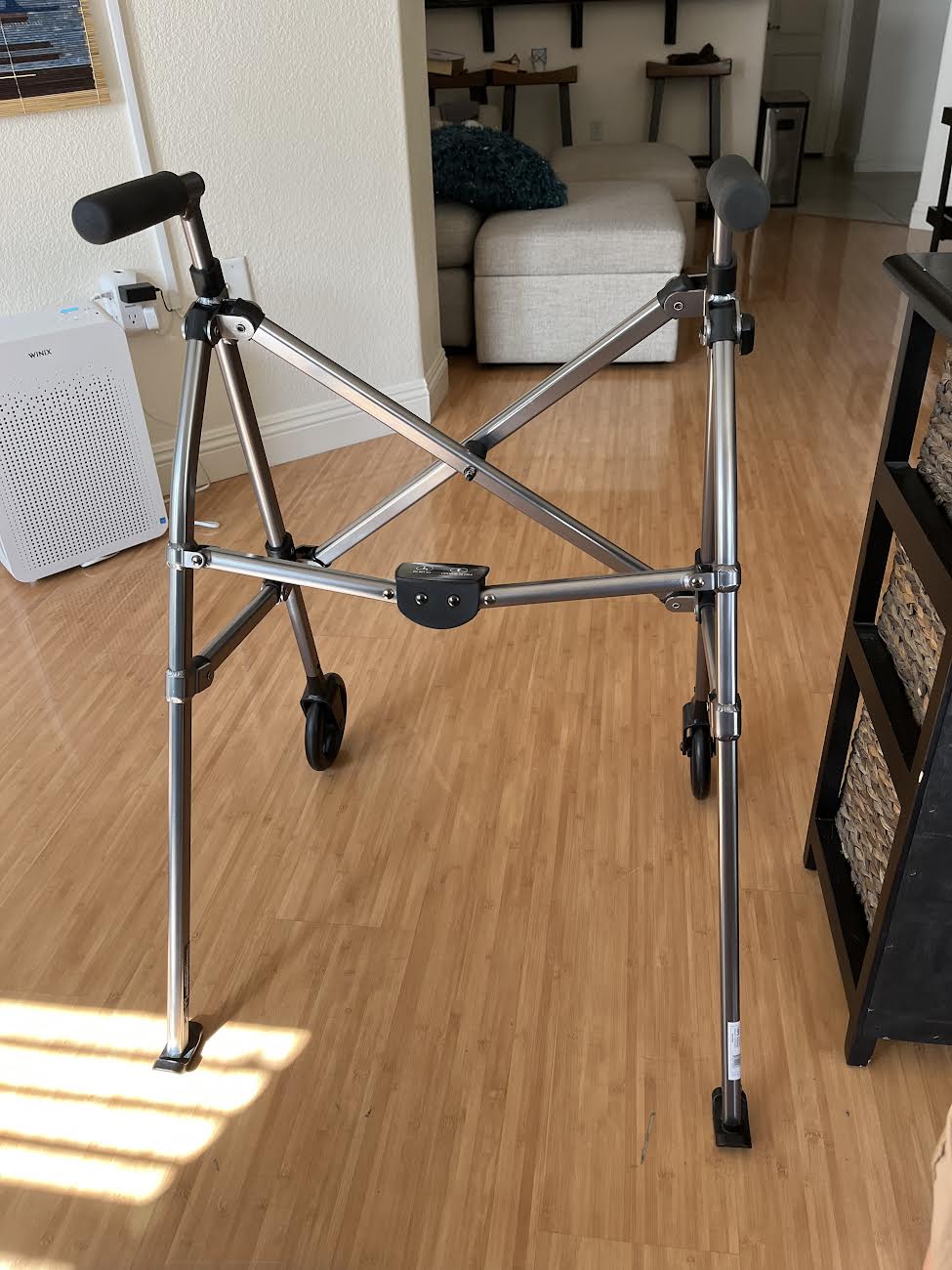
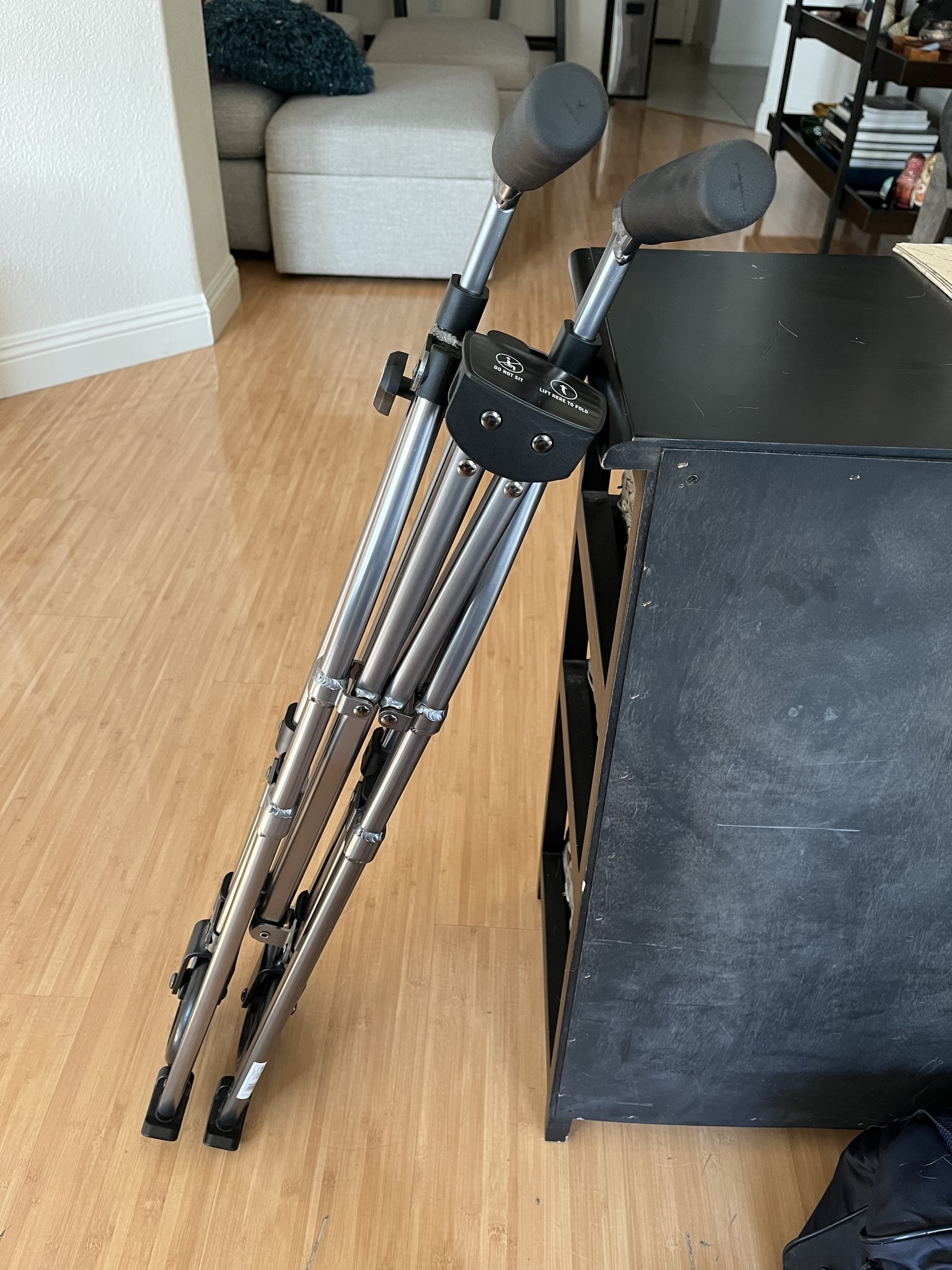
I have to be honest. I burst into tears. A WALKER! Not for the first time, I played with the idea of losing capacity. And I didn’t like it. “I’m sorry. I can’t make that decision”, I said. “I need to get off here before I really start bawling. You do what you think is best.” And I hung up. I am lucky that Andrew is such a patient person. He came home, brought me the knee brace, and helped me put it on. My knee felt immediately better, but I still couldn’t walk on it. “Hey”, he said. “You have hiking poles. Do you know where they are?” “The front closet”, I replied. When he brought those to me, we immediately knew they wouldn’t work as they had sharp metal points on the tips. Bless his heart, he let me say it out loud. “These aren’t going to work either.”, I said. He nodded. “So, just try this”, he said as he brought out the walker. It was cool, collapsible, lightweight with wheels on the front ends. Then he made a joke about me practicing for when I’m 90. “Too soon”, I said and I burst into tears again.

I’ve now been using the walker around the condo for 4 days and on limited trips outside. My knee is feeling better. I’ll have to wait until I’m approved by my PCP to see a doctor about my knee and I’ll definitely wait until after my eye surgery, but in the meantime, I’m using my brace and my walker, and I’m grateful. I’ve become a poster child for the Walgreen’s Space Saver walker. At doctor’s appointment and on the street, people using more traditional walkers stop me and ask me about it. I let them try it out, see how lightweight it is and how easy to collapse.

I know my using a walker is temporary, at least this time. My attitude has again shifted and I view my walker as a tool and my knee pain as slowing me down to protect my eye prior to surgery. I’m also viewing my knee pain as a reminder that I should not be schlepping too much, just as my wrist pain reminded me of that during our recent move. My body is strong and resilient, but she has limits, limits I need to respect.

Adventures in aging – Part 1: A partially detached retina, problems with my PCP, a trip to the ER, and great care at Desert Springs

I won’t lie. This last week has been rough! It challenged how I see myself, how I see, literally, and my self-concept and beliefs about my capacity. The universe decided to remind me that I’m not a kid any more,… or a young adult,… or even middle aged, as more than half my life is definitely behind me. It also reminded me that my body is strong, resilient, and that sometimes things need extra care and support. I need to stay vigilant.

I woke up one morning and immediately started getting things done, like I do. I collected paperwork for my editing partner, Victorine Mbong Shu, negotiated with a local independent bookstore about doing a book event for Writing about Motherhood Honesty in Wichita in November, communicated with coaching clients, forwarded an invoice for a friend, finalized my ballot for the upcoming election, did laundry, made turkey salad for lunch.

As I was working on the computer, I noticed the vision in my left eye was, well,… strange. I seemed to be looking around my left eye. Upon closer attention, I had a big dark semi-circle from my nose halfway through my vision in my left eye. I couldn’t see anything through it. I realized I had been working like this for a while that morning, looking around part of my vision. Our brains are amazing things!

I thought “Oh crap! Ocular migraine!”, so I took some Rizatripton and Advil and continued about my day hoping to stave off the nasty headache I expected. As I made the turkey salad, I noticed that my spot was not resolving. “Hmmm… This is new.”, I thought “Oooo! What if this isn’t a migraine?”

Since I’m new to Las Vegas, I have new insurance, a new primary care provider, who I have yet to meet (changing that), and as it turned out a lot of red tape to sort out. My primary care provider’s receptionist told me that they would have to verify that I was a client with my insurance provider, have their supervisor review my materials, and approve me as a new client prior to meeting with me… And this could take up to a week… Crickets.

My mind was racing. This seems like it might be serious! Stroke, aneurysm, blood clot, retinal detachment all ran through my mind. “I don’t have a week to wait. I think this may be serious”, I said. “I’m sorry. That’s our policy”, she said. I tried to joke; I tried to persuade; I tried to plead; I tried to bargain. “What should I do?”, I asked. “I can’t advise you. You’re not our client”, she replied. I gave up.

I called Humana, my insurance company and asked what I should do. To make a very long story short, they sent me to the ER. Good decision. They sent me to Desert Springs Hospital Medical Center. “Hi, I’m Dr. George”, the doctor said. “Hi, I’m Dr. Deborah”, I replied, joking. We first talked about what kind of doctors we were, our specialties, our training, etc. Through it all, he was assessing my condition. “I think you detached part of your retina”, he said, but I want to be sure. Over the next several hours they ran CT scans, CT scans with contrast, ultrasounds, an EKG, blood tests, etc. They were incredibly thorough. Desert Springs is a teaching hospital, so under strict supervision, there were residents, interns, med students, and nursing students caring for me. I recognize the need for teaching hospitals. Teaching is extremely important and everyone who worked with me was professional and highly skilled.

The tests, confirmed Dr. George’s diagnosis and we headed out for the day with an appointment to see a retina specialist at 7:45 am the next morning. I left feeling very satisfied with my care and more respectful of my body. But she and the universe weren’t done with me yet… (more on that later). Oh, and Dr. George called me the next day to follow up and see how I was doing. I appreciate that kind of care.

The silver streak in this video is the detachment line of my retina. Pretty cool video!

Connection, preemies, and African violets

I’ve been thinking about African violets today. When I was little and just starting to learn about plants, my grandmother told me that African violets thrive best when the leaves of different plants touch one another. I am like an African violet. Touch and connection are critical if I am to thrive.

I’m thinking about connection because of an experience I had this morning. Andrew has a cool brain wave machine to help you relax, sleep, concentrate, or whatever you need to do. It has alpha, gamma, delta, and beta waves depending upon what program you choose. I haven’t been sleeping very well (jet lag) so I was going for relaxation, alpha waves. I’ve only tried the machine three times and each time I’ve had some really interesting insights. I write about today’s insights below.

There are a lot of amazing and wonderful things going on in my life, but I’ve also been feeling a level of angst and distress that I couldn’t explain.

I realized during the session this morning that my distress is about connection. I view connection as the most basic and fundamental of human needs.

I was born two months prematurely and spent the first month of my life in an incubator. I was born in my grandmother‘s home and the doctor, who arrived shortly after my birth, immediately took me away from my mother and rushed me to the hospital. He put my mother to bed for two weeks to recover, because apparently that’s what you did at that time. My aunt, who became my godmother, came to visit my mother shortly after my birth. She came to the hospital to see me as well, once. Because I was in an incubator for the first month of my life, I was not held. I was touched minimally. The belief was that I needed all of my energy and attention to be focused on growth. During that month, I largely grew alone.

My father and his parents met the doctor at the hospital almost immediately upon my arrival there. They could only see me in the incubator across the room.

This reality of separation has led me on a lifelong journey seeking connection. I have not been very successful at achieving that. I am estranged from my biological family for reasons I will not get into here. I do not communicate with my mother or any of my siblings. I thought I had found enduring connection with my husband. I felt that we were soul mates. While we were wonderful together for a long time, that ended as well. We have two children, a son and a daughter. I felt so connected to and needed by these amazing beings. I was their center, I grounded them as they grew. When they were born I wished for both of them to be strong, loving, and independent. They are both exactly that, in their own unique ways, and so much more. I wished for them to be close to one another always, to be able to rely on one another. After all our siblings are often the longest relationships of our lives. My siblings and I were not raised that way. Closeness with my siblings was what I desired, and so, what I wished for my children.

With Covid, and the trajectories of our lives, I have felt my connections with my children weakening. Not our love for one another, but our willingness to reach out to one another both for casual everyday connection, and in time of need. Maybe that’s just a natural part of the growth process. My children are adults with their own lives.

Our weakening connections have been especially hard. I view our connections as part of what makes us strong and able to manage anything that we’re faced with in life. I do not believe that any one person can ever meet all of the needs of another person. I believe that all of our important relationships offer something unique and of value that is irreplaceable. I have often said that the reason I am able to go out big in the world is because I have my people to come home to, figuratively if not literally.

Being locked down through Covid and physically separated from my son and daughter for longer than ever before has been extremely hard on me. I haven’t seen my son in two years. I’ve been fortunate to have seen my daughter several times during this time, but far less than usual. The physical distance is hard.

I am blessed with a wonderful partner, also a preemie, who loves me, understands me, and supports me more fully than anyone ever has. He truly sees me and his desire for connection matches mine. I am fortunate that I have found my home with him. He is my person. He is my heart.

In many cultures around the world the bonds within families, the bonds between parents and children endure and are strong for a lifetime. I wonder why in our culture we push so hard for independence and doing things on your own. That seems unnecessarily difficult to me. I wish that we could recognize the importance and significance of the basic human need for connection. I wish we cherished and nurtured those connections that make life so much fuller and richer.

Maybe I feel this need for connection more strongly than others do because of that first month of going it alone in an incubator. Maybe that’s why I understand the African violet’s need to touch in order to thrive.

Forgiveness and Anticipatory Hope

“Forgiveness is giving up the hope that the past could have been any different.” – Oprah Winfrey https://chopracentermeditation.com/ *

I don’t hold grudges. I don’t harbor resentments. For much of my life I simply forgave and forgot any transgressions against me – to the point that one night, over dinner, my best friend and my ex-husband recounted all the negative things that had happened to me since they’d known me. When they recounted the events, I knew they had happened, of course. I just didn’t value them enough to remember them. I might not even have been able to recount them without their prompting.

What I do hold onto is what I call anticipatory hope. Anticipatory hope is my belief that the bad, the negative, the hurtful, the lack in my past could have been different, if people had made different choices. Because I believe these alternative choices were possible then, I believe they remain possible in the present and in the future.  

In a recent conversation with my daughter about an upcoming event we were both dreading, she was lamenting all the negative things she expected. I was trying to lift her spirits talking about how this time things might be different. Alyssa paused, looked me full in the eyes and said, “That’s your problem, Mom. You always look on the bright side. You always believe people can be better, that they will be better. When they don’t, when they act like they always act, you feel let down and hurt. That’s the downside to you always having this anticipatory hope thing. It’s exhausting. You’re not realistic.”

Alyssa in her blunt, no-nonsense way had really hit on something. I’ve always viewed my anticipatory hope as a strength. It helps me be optimistic, remain positive in difficult moments, see possibilities.

Because I believe that anything is possible, that anyone is capable of making a different choice at any moment, it is hard for me to release those in my life who repeatedly choose to be other than who they have the capacity to be – to be honest, those who are damaging to me. More importantly, I hope they will treat me differently than they chose to treat me in the past.

When I first heard the meditation at the opening of this post, it was as if I had been punched in the stomach. Sometimes truths are so profound that when confronted with them, they change something immediately and fundamentally. Sometimes they are the catalyst for a more gradual transformation. For me, this truth was both.

I listen to these meditations to help me sleep. After hearing this statement, I knew there would be no sleep that night.

I turned to my journals for insight and realized I had been writing about the same issues for 1, 5, 10, even 20 years! My anticipatory hope made it impossible for me to let go, to move on.

I believed I had forgiven. But in the same way that holding grudges, harboring resentments, not forgiving, keeps us from releasing the past and moving forward, anticipatory hope does the same. Because I held onto anticipatory hope, I had not released those I needed to release.

I am still a work in progress. Releasing the “what could be” is hard. It’s a desired future we hope for. It holds us bound to the past, hauling the weight of the past into the present and the future. Releasing that burden. Releasing those who are not who we wish they were (which, to be honest, is not their job in the first place) is true forgiveness. And, in the long term, a gift to them and to me.

* 21 Days of Meditation – Finding Hope in Uncertain Times

Reflections: On my worst (and best) Thanksgiving ever

Let me say first I LOVE Thanksgiving! It is my favorite holiday of the year. I love to make a big dinner for my family. For us there are traditional “must have” foods: monkey bread in the morning, and for dinner, turkey, homemade stuffing, mashed potatoes and gravy, green bean casserole with fried onions on top, 7-up salad, homemade bread, cherry cheesecake and homemade pumpkin pie. Without these foods, it just isn’t Thanksgiving.

At least that was the case until two years ago on Thanksgiving. I had fallen the month before at my favorite academic conference. When I fell, I broke both my wrists. The weeks leading up to Thanksgiving were difficult ones in a variety of ways. I was learning how to be helpless. I was accepting with as much grace as possible that someone else had to do absolutely everything for me. I was dealing with incredible pain.

I was also dealing with the fact that my daughter, who had a job in retail, and who was a student at UNLV, a 19 hour drive away, was not going to be able to come home for Thanksgiving. I was trying to cajole, persuade, manipulate my son into accepting my plan that he and I should fly, or drive, to Las Vegas to be with his sister. I was desperate! Our going to Las Vegas was completely unrealistic on a lot of levels, not least of which was my physical incapacity, the exorbitant price of airfare just days before the holiday, and the fact that there was no way I was up to a 19 hour drive. But I just couldn’t handle the idea that we would not all be together for Thanksgiving.

This was a very emotional time during my healing process. The day before Thanksgiving my daughter messaged me and asked me for the recipe for 7-Up salad. As it turned out she was going to be able to have Thanksgiving dinner with some friends in Las Vegas after all. I did not respond well to this request. In fact, it made me cry. I no longer have the text messages that we sent back-and-forth. Stefan typing for me or me voice texting. But I know they went something like this. Me: “Wait! I thought you had to work all day on Thanksgiving! But I want you to come home and be with us! I miss you! :-(” Alyssa: “Mom, I just get to have dinner. I don’t have the whole day off. If I could come home I would. I can’t. You know that. So will you give me the recipe or not?” I gave her the recipe. “Stefan”, I began after Alyssa hung up the phone. “Mommy, we’re not going to Las Vegas”, he replied gently. I burst into tears. It’s hard to cry with both your wrists in splints when someone else has to wipe your tears and hold the Kleenex to help you blow your nose. I felt hopeless.

As it turned out, this was my best Thanksgivings ever!

I was moping around the house on Thanksgiving Eve when Stefan told me he had to run an errand. “Ok”, I replied without much enthusiasm. I don’t think I even offered to ride along. “It will take me a while. I have several stops to make”, he hollered from downstairs. “No problem”, I replied. “Be safe. I love you.” I curled up on my bed in the dark and waited for him to come back. I think I dozed off.

When Stefan got back he hollered up the stairs, “Hey Mom, I’m back. Can you come here a minute. I have something to show you.”. “Ok, I’m on my way”, I replied. As I turned the corner of the staircase I saw my beautiful daughter sitting on the couch. She jumped up, “Surprise”, she hooted. I burst into tears. She ran across the room and wrapped her arms around me. “I didn’t mean to make you cry; this was supposed to be a good surprise”, she said. “It’s a wonderful surprise”, I sniffled. “These are happy tears”. I rested my head on her shoulder as she wrapped her arms around me. Stefan wrapped his arms around both of us and we just stood there, happy to be together.

Alyssa had gotten the whole weekend off, purchased her plane ticket, and collaborated with her brother to surprise me. It was the best surprise I could have imagined.

That weekend, Alyssa took over my care, helping me shower, dress, brush my teeth and hair, manage the bathroom. She fed me with ease. I felt her love, care and compassion. I observed her learning, at her own rate, how to care for me, as I learned how to relax into her rhythm. I was still emotional at times, but incapacitation, pain medication, happiness, and holidays will do that to me.

We ended up having an amazing weekend. It quickly became clear that I had made no plans for Thanksgiving dinner and that I couldn’t cook anything. Alyssa said that was no problem as she and Stefan had decided we were just going to spend the weekend making our favorite foods and hanging out. She said, “You can tell us what to do, Mom, and we’ll do it!” We focused on comfort foods. I stood in the kitchen, or in the dining room looking over the counter, giving instructions. We made macaroni and cheese, 7-up salad, and monkey bread. Everything was delicious.

We snuggled in bed together and watched movies and all the episodes we could find of “Once Upon a Time”, Alyssa’s favorite show. I slept a lot. I would awaken to the sound of Alyssa and Stefan’s laughter or quiet talking. I would either smile and drift back to sleep, or wake to spend time with them. I was still on pretty heavy pain medication most of the time. But I was surrounded by the two people I love most in the world, my children. I thank my daughter for doing all she did to be with me, and her co-conspirator, my son, for giving me the best Thanksgiving ever.

Sidelined by Broken Wrists – Part 4 OR Why I <3 Dr. Jason Mettling, DPT

Some context: After the dancing accident, when it was clear I was hurt, my friends took me to an emergency room in Tacoma, Washington. When the x-rays came back, I learned that I had a triple fracture in my right wrist and a double fracture in my left. Miraculously, the fractures in both wrists were clean and there was no bone displacement. The physician in the ER put my arms, from elbow to finger tips, in cloth wrapped, plaster-based splints that went up the underside of each arm to the center of my palm. I curled my fingers forward over the lip of the plaster and once it hardened, the doctor wrapped gauze, then elastic wraps around my arms to my fingertips. He then put me in slings that crossed my arms over my chest, hands facing upward, and held them in place. The goal was to keep anything from moving until I could be assessed by an orthopedic surgeon. The ER doc said he hoped that nothing would move and that I would be able to avoid surgery and metal plates in my wrists.

When I got home to Wichita, my family physician took more x-rays thinking he’d just put me in casts. When he saw the extent of the damage and the fact that everything was still in place, he sent me to an orthopedic surgeon. My ortho doctor took more x-rays and as nothing had moved, decided to leave the splints on for several more weeks so that my wrists could start to heal. He said that if nothing moved in several weeks, we might move on to casting. If anything moved or was misaligned, he said, I would need surgery. After several more weeks, nothing had moved and my ortho doctor decided to keep me in splints a bit longer. He did think it was time to get my fingers moving again, so he cut the splints and the wraps to the base of my fingers so that I could move them. My fingers had been structurally paralyzed since my fall and it felt like there were fiery needles running through them when I tried to move them. The pain was excruciating.

That afternoon, I met my partner in healing, my physical therapist, Dr. Jason Mettling, DPT. To say that Jason played a pivotal role in my healing and recovery would be an understatement. He was critical to my mindset as I slowly regained capacity. He was kind, compassionate, always encouraging, always pushing (literally!!! and figuratively). He was funny; he was supportive. He was exactly the kind of engaging, involved partner I needed in physical therapy. Our personalities, our goals, my fears, my independence, my need for support, his firm direction, his clarity of purpose, his willingness to listen, to explain, and to explore, made us a perfect partnership for this stage of my healing adventure.

I was apprehensive about physical therapy. I was afraid of the pain and I was terrified that I would not be able to get full function back in my hands. Dr. Mettling built my trust from the beginning. I assumed that when the splints were cut I would be back to normal. I was wrong. I could barely move my fingers. I couldn’t touch my fingertips to my thumb. I couldn’t curl my fingers or make a fist. I had to learn to use my fingers, and later my hands, wrists, and arms all over again. This was going to be an uphill battle. When I first met Jason, he asked me if I trusted him. I replied, “I don’t know you.” He looked me straight in the eye and said “I can get you back where you were, but you have to trust me. It’s going to hurt, sometimes a lot, but there is a reason for everything we do.” His words helped counter my fear and gave me hope for a full recovery.

During our time working together, there were many ups and downs. My level of pain surprised both of us at some points. During one session I almost passed out due to the intensity of the pain. We strategized when I would take pain medication so that I would be able to work hard and endure during each session. As I reflect on Jason’s approach, I see him as a gentle torturer. He pushed me for the progress he wanted, both literally, as he applied pressure on my wrists to help increase my flexibility, and figuratively, encouraging me to do my homework.

During this process, I developed a serious dislike for wooden clothespins. Once I could get my fingertips near one another again, my next task was to regain finger flexibility and strength. My least favorite exercise involved holding a wooden clothespin between my thumb and a finger and opening and closing it. To begin with, I couldn’t open them at all. Later, I could open them a bit. Today, I can open and close a clothespin multiple times with each finger / thumb combination on both hands. I enjoyed playing in 3 pounds of raw rice more. This exercise had two main purposes. One was to get me used to resistance and to build flexibility. The second, in some ways more important purpose, was to reduce the hypersensitivity my hands and skin had developed after the accident. Any touch was painful. At first I had to put the rice in warm water and swish gently. As I overcame a bit of the sensitivity, I could play in the dry rice, moving my fingers through it, making fists around it, burying my hands in it.  I loved the tactile nature of this exercise and the progress I could see myself making.

One of the things Jason did especially well was see the advances I made and celebrate my progress. He was always encouraging. At times, this was what kept me going. I’ll never forget how hopeless I felt when I went to see my orthopedic surgeon (how telling is it that I can’t remember his name, but Jason’s comes easily to mind) and he wanted me to put my arms straight down in front of me, backs of my hands together, and then raise my arms along my body until my lower arms were parallel to the floor, all the while keeping the backs of my hands together. When he demonstrated it, I thought, “I don’t think anyone can do that! How did he DO that?” To do that, you need to bend at the wrists and elbows and keep your shoulders down. It is hard! Really! Try it! I couldn’t do it. I was only a little better at the next behavior he demonstrated. He wanted me to put my palms together in front of my face, fingertips up, and lower my arms along my body, again bending my wrists and elbows until my hands were in the Namaste position and my lower arms were parallel to the floor. While I could at least understand how this movement was possible, I couldn’t get anywhere near it. I can now do the latter one. I’m still not even close on the former. I challenge you to try both to see what I mean about how hard they are. I went home from that appointment depressed. I wasn’t making progress. I was FAR from making progress. I should be able to DO these things.

The next morning I had PT with Jason. I was still bummed when I arrived. “What did the doctor say”, he asked. I paused, “Basically, he wants me to be able to do things I’m nowhere near being able to do and I’m really frustrated”, I replied. “I thought I was doing so well.” Jason reminded me that I had been incapacitated through splints, casts, and was only now beginning to get out of my braces for short periods of time, that this would take time. He reassured me that I was doing great and that I would get there. The most important thing he told me was to remember that with the kind of injury I had, incapacitating me was the best option. We avoided surgery that way, which often leads to less satisfactory long-term outcomes. And while my short-term outcomes were more painful and more frustrating, in the long run, I would be better off. He said he understood my frustration, but that I needed to remember that my muscles had been unable to move through the splint and cast phases and that I was rebuilding my muscles and retraining my nerves. I just needed to be patient. Patience had never been one of my strong suits. I’m a “get ‘er done” kind of person. Breaking my wrists changed that, slowly, but surely.

Several times during my therapy, I hit a plateau. When this happened, it was frustrating and fear inducing. Was this the best I was going to be able to do? Had I reached my limit? During one particularly frustrating plateau, Jason came up with the idea of having me come in 15 minutes early for my appointments and put moist heat in the form of large pads around my wrists to help them loosen up and get ready for our work. That helped me get beyond that plateau.

When Jason told me we were coming to the end of my need for PT, I was scared. We had come so far, but I felt I had so far yet to go to get “back to normal”. I learned through this adventure that there are three stages in recovering from a temporary, incapacitating injury. The first and second stages overlap a bit. The first stage is simple healing. For me, this lasted 3 months as my wrists were first in slings, then in casts, then in braces. The second stage began when my orthopedic surgeon cut the tops off my slings so I could learn to move my fingers again. The pain of reactivating muscles and nerves, dormant for months, was almost worse than the pain of breaking my wrists in the first place. Then I got casts, which allowed me to do more finger work. After the casts finally came off, I went into braces which I could remove for physical therapy and to do my “homework” and which allowed me to learn to use and rebuild strength in my wrists and arms again.  I wasn’t prepared for the pain involved in this second stage or how slow the process of healing and regaining capacity would be.

When PT ended, I was ready for the third stage in recovery, refining skills and building strength over time. Slowly, I regained more and more capacity. I remember the first time I brushed my teeth. It felt amazing! I remember the first time I fed myself. My son took me out to a restaurant and I got a BLT which he cut into pieces so I could pick them up and feed myself. I remember the first time I put mascara on. I remember the first time I cut up vegetables to make a soup. Each first was hard. Many of them hurt. But, one by one, I learned to do things for myself again! The last three milestones were successfully brushing my long hair and pulling it back in a band, scrubbing my back in the shower, and hooking my bra. Life’s simple pleasures. I still might need help with a particularly difficult lid once in a while. Squishy water bottles are the worst. While I still fear hot yoga (particularly sun salutations – the downward dog to plank to chaturanga, back to downward dog part gives me heart palpitations), overall, today, little more than 2 years after I fell, I can do anything I desire. Maybe after my Florence adventures, I’ll head back to hot yoga. I thank Dr. Jason Mettling for being my inspiration, my cheerleader, my taskmaster through physical therapy. I thank him for being such an important partner in my healing adventure!

On the Importance of Support for Health Care Surrogates: The Middle of the End of SOB (Sweet Old Bill)

One day, each of us will die. I have come to believe that Dylan Thomas had it wrong when he argued that we should “Not go gentle into that good night”, that we should “Rage, rage against the dying of the light”. I now believe that going gentle into that good night is sometimes the definition of a good death. So many factors go into a good death, particularly in a culture as death averse as ours. I cannot say whether or not my uncle had a good death. I can say that he met death on his own terms. That, however, is a topic for another day. Today I want to talk about the people who made the role I played as his health care surrogate easier, because being a surrogate in the U.S. still often means dealing with a medical establishment bent on raging, on defeating death. As I helped my uncle navigate the end of his life, I was fortunate to have three strong advocates supporting me.

My maternal aunt (my uncle’s sister), a nurse, helped me stay clear when I doubted myself or my choices. She reinforced the importance of my role as my uncle’s health care surrogate, and commiserated with all the craziness I faced when dealing with insurance companies, medical providers, long-term care and rehabilitation facilities, our family, and my uncle’s friends. She let me rant. She let me cry. She listened and advised. To my aunt, I say “Thank you for your compassion, your calmness, your willingness to troubleshoot with me, your clarity, your unwavering confidence in me, and your kindness. Doing this without you would have been so much harder.”

My second support person was my friend Andrew who was there for me because he loved me. He asked the hard questions and supported me in making the tough decisions. He helped me stay clear, encouraging me to write things down, so that I would have my own words to help me sort through issues as they arose, so that when my decisions or motives were questioned, I would have clarity for myself. I wrote. Reading what I wrote at various points helped me to remain strong in supporting my uncle’s wishes. To Andrew I say, “Thank you for your insight, your  intelligence, your compassion. Thank you for holding me as I cried, for driving me to the airport, for picking my up from the airport, for bringing me flowers, for loving me through this difficult time. You are a treasure.”

My third support person was the case oversight doctor at the rehabilitation hospital. He became my lifeline. He reinforced my uncle’s right to decide, made me aware of what I would face as I advocated for my uncle in the rehabilitation hospital, and helped me negotiate the care decisions we faced. To this physician, I say, “Thank you  for helping me reach and maintain clarity, for helping me understand the mindset and motives of health care providers, for preparing me for all the challenges I would face, and for fortifying my commitment to “stay the course”, even when making a different choice would have been easier.”

As I’ve said, I’m a health communication scholar. My academic and personal work prepared me to serve as my uncle’s health care surrogate as he negotiated the end of his life. I had over two decades of my own research. I had my experiences with colleagues and friends from the Nevada Center for Ethics and Health Policy. I had tools others may not have as they take on this role. These resources didn’t change the fact that I continually and painfully second guessed myself throughout this process. They didn’t prepare me for who I was as a person, a niece, helping someone I loved in the process of dying. They didn’t prepare me to negotiate this process with health care providers, family, and friends. My second guessing came mostly from the reactions of my family, my uncle’s friends, and medical providers who disagreed with my uncle’s decisions or questioned my motives. I’m a conscientious person. If people question me or my motives, it kicks me into a process of self-reflection, looking for chinks in my commitment, in my motives. My support people made this process and all the decisions associated with it bearable.

I’m going to spend the rest of this entry talking about the case physician in the rehabilitation hospital. He and I never met in person. Through several phone calls, he understood that my uncle did not want to do anything to prolong his life: no medications, no surgeries, no hospitalizations, no invasive treatments. He also understood my uncle’s desire to be as healthy as he could for the time he had left. The doctor agreed that continuing to regain or at least maintain his strength and physical capacity through physical therapy and occupational therapy were appropriate. He also recommended speech therapy to assess whether there were any swallowing or food management issues that could be improved. He helped me stay logical and pragmatic in the face of significant resistance from health care providers.

I remember at the end of one conversation he told me that this was not going to be easy. He told me I would have to stay strong in the face of well-meaning health care providers who thought my uncle’s decisions were wrong. He told me that well-meaning health care providers would try to “gaslight” me. I asked what he meant. He said, “They will identify crises that will require more extensive medical procedures and hospitalizations. They will want to call ambulances and administer emergency treatments to save or prolong your uncle’s life. They will call you at all hours of the day and night with emergencies you need to make decisions about right then. They will not want you to take time to think”. He concluded, “No matter how they gaslight you and how urgent the emergency they present you with, you need to go down your decision tree. Given his decision and your commitment to advocating for it, except for keeping your uncle comfortable and pain free, you aren’t going to do anything else. Right?”. “No”, I answered, “Good”, he said. “You’re clear. Stay that way. Call me any time you if you need me. I’ll call you when I need you”.

He was right. Nurses called me at all hours of the day and night. The preferred time seemed to be 3 a.m. and each emergency required my approval of immediate hospitalization. Sometimes they called 911 in direct contradiction to the “no 911” directive. Twice they called to inform me that ambulances were on the way. In both cases, I refused them. The first time the nurse said, “That’s what your uncle said. We hoped you’d have more sense.” His advance directive paperwork was misplaced multiple times. The post-it notes the case physican left to reinforce the directives in his chart were either removed from the chart or the workstation, or accidentally covered up, leading to the ordering of multiple tests and procedures I had to then refuse. Late one night they called to tell me my uncle was having mini-seizures. They wanted to hospitalize him for tests. On another occasion, they thought he was throwing blood clots and that the circulation in his right leg had been cut off. On both occasions, I was lucky that the case physician was available to talk me through the crisis. He asked if I would allow surgery. He asked if I would allow any treatment beyond pain medication. My answer was “No”. The physician concluded, that it didn’t matter then if my uncle had had a stroke. Observation would confirm that diagnosis or not. It didn’t matter if he was throwing blood clots or if the circulation in his leg had been compromised. Again, observation would eventually confirm whether or not this was the case. Since we weren’t going to accept any kind of treatment, the diagnosis didn’t matter. Helping me work through the decision path, it became clear that to support my uncle’s wishes, all treatments had to be refused. He helped me understand that the health care providers in the rehabilitation hospital were only doing what they believed best, trying to prolong my uncle’s life.

These situations led me to repeatedly question my uncle’s desire to “let nature take its course” and my desire to support him in that decision. Was this the time? Could he still live a high quality life – if only we did this or that intervention? My experience as a health communication scholar and the support of my advocates allowed me to stay the course in each case, as did my uncle’s unwavering commitment to the path he’d chosen. As loved ones of those who are dying, our hope often leads us to accept medical intervention that will not prolong a quality of life and often only minimally lengthen the duration of life. Being a health care surrogate at end of life is not easy. It is, however, critically important in a culture that is death averse and within the context of a medical establishment that views death as a failure. Sometimes it is appropriate to rage against the dying of the light. At other times, it is a gift to allow a loved one to go gentle into that good night.