Tag Archives: Cancer

My Breast Cancer Journey: The Gift of 2 Days Feeling Like Myself

The last 2 days have felt magical. I have felt 100% like myself. I have felt present in my body, comfortable in my emotions, full of energy and love. I have felt like me. That is a big statement as I haven’t felt like me since I was diagnosed with breast cancer had a double mastectomy in May and went on cancer treatment meds in June.

I wrote about some of this before, but to manage the side effects from my breast cancer treatment, the first medical oncologist I saw last June, put me on anastrozole to suppress my hormone production and 75 mg of venlafaxine a day to manage hot flashes and other side effects of the anastrozole. 

I should’ve asked more questions. I should’ve been more vigilant. I was a great advocate for myself in terms of not wanting some of the side effects that the anastrozole was likely to create. However, I was not vigilant enough about the remedy that he chose. 75 mg of venlafaxine, an antidepressant, changed my brain chemistry. In the words of my second medical oncologist, I might have thought I was treating hot flashes but my brain thought something else. 

With her agreement, I decided to go off my cancer medications a month prior to our honeymoon cruise to the West Indies over Christmas and New Year’s. I wanted to see what it felt like to feel “normal”. 

I know it’s dangerous to go off antidepressants cold turkey but I didn’t realize I was on one. What followed was a 12-day ugly-crying spree. I don’t think I’ve ever cried that much in my entire life, over anything. Those of you who know me well know both that I have gone through some pretty cry worthy experiences in my life (haven’t we all), and that I cry easily and with no shame. In the words of Jude Law’s character in Holiday, “I’m a major weeper”. I cry at poignant movies. I cry when I’m happy. I cry when I’m sad. You get it. I cry. But this was different. I felt so low emotionally and I cried uncontrollably, almost constantly. It wasn’t until two weeks later that I had an appointment with my medical oncologist and she informed me of my error, that I could not go off venlafaxine cold turkey. So I went back on it. Not what I wanted to do, but I also didn’t want to spend our honeymoon cruise crying.

On January 8, after returning from our cruise, my doctor and I came up with a plan to safely wean me off the venlafaxine. She shifted my dosage from 75 mg a day to 37.5. She wanted me to take this dosage daily for 21 days, then reduce it further to every other day. I completely weaned myself off the medication five days ago. The first couple days I had moments where I felt hyper emotional, but they were short-lived. I felt optimistic. I felt that I could do this.

And yesterday was the gift I had been waiting for. I woke refreshed, ready to start the day, and happy. No distress. This is how I typically wake up, at least I did until last April. 

I don’t know what decision my medical oncologist and I will make when I see her this week about resuming my cancer medication. That will be largely determined by my tumor markers and my decisions about quality of life and the risk of cancer recurrence. Initially, my odds were very low. I hope that is still the case. I do know that feeling like myself is a godsend.

On our cruise

I want to be clear, this is not a tale of advocacy. I would never tell anyone what to do on their cancer journey. Everyone’s cancer journey is unique. Everyone’s experience with medication as unique. 

This is a cautionary tale, a tale about asking the right questions at the right times and not making assumptions. Today, March 3, I feel normal. It took just shy of two months. I embrace this gift today. Today, I’m not worrying about the future. I’m just reveling in feeling like me. 

On asking the right questions and the importance of a healthcare advocate 

Wow! Yesterday was a day! I’ve always thought of myself as a healthcare advocate—someone who asks the tough questions, navigates complex systems, and helps others feel empowered to make their own health decisions. Yesterday, I realized just how different it can be when you’re advocating for yourself.

What I learned is that having a healthcare advocate isn’t just important—it’s critical! You need someone in your corner who can look at a situation from multiple perspectives, who checks, double-checks, and follows up on every question, making sure everything is clear. I hope in sharing this experience I will help others avoid this pitfall.

Here’s what happened: In June, my medical oncologist in California put me on two medications—Anastrozole to suppress estrogen and progesterone and reduce the chances of the breast cancer coming back, and Venlafaxine, to help manage the hot flashes and other menopause-like symptoms caused by the hormone suppression. Venlafaxine is typically used as an antidepressant, but for me, it was all about managing side effects.

Normally, I’m incredibly thorough when it comes to my healthcare. I research every option, weigh the side effects, and think carefully about alternatives. But this breast cancer journey has been different. I’ve been trying to keep up with it all while leaning on my amazing husband Andrew, my fantastic medical and surgical teams, and the open, collaborative conversations we’ve had. Even so, I learned yesterday that I don’t always ask the right questions—and it’s made these last two weeks feel way longer than they should have.

I didn’t love the side effects of these medications, so I talked to my Las Vegas medical oncologist about going off them for about a month. With our honeymoon/Christmas/New Year cruise coming up, I wanted to feel like myself again, free from side effects. She agreed, saying I should know what “normal” feels like and we’d reassess after the cruise. At least, that’s what Andrew and I thought she said.

Turns out, we weren’t quite on the same page. She saw Anastrozole as my cancer treatment and Venlafaxine as an antidepressant. I saw them both as part of my cancer treatment—Anastrozole to treat, Venlafaxine to manage side effects. So when she said to stop “the meds,” I assumed she meant both. She didn’t. 

Two weeks ago, I went cold turkey off both medications, thinking it was the logical thing to do. If I didn’t need the Anastrozole, I wouldn’t need Venlafaxine, right? Wrong. What I didn’t realize was that stopping Venlafaxine suddenly would lead to intense withdrawal symptoms—way worse than the side effects I’d been trying to avoid. The past couple of weeks have been awful. I couldn’t sleep (or if I did, I had vivid nightmares), I was constantly bouncing between feeling too hot and too cold, had headaches, nausea, dizziness—you name it.

I’ve supported friends and family through antidepressant withdrawal, so I know how important it is to taper off these medications. But I wasn’t thinking of Venlafaxine as an antidepressant; I thought of it as a tool to handle side effects from my cancer treatment. It didn’t even cross my mind to ask about withdrawal effects, and my doctor didn’t bring it up either. She just told me I’d feel better and to enjoy the cruise.

Fortunately, I had an appointment with her yesterday and I realized my mistake.  As soon as I got home, I started taking Venlafaxine again because I don’t have time to taper off safely before the cruise. I’m already feeling so much better and should be back to normal in a couple of days.

This has been a tough lesson, but I’m taking it forward with two new questions to ask: “How long do I need to take this?” and “What happens when I stop?” I’m hoping these questions will save me and others from this kind of experience in the future. For now, I’m focusing on feeling good and making sure our cruise is everything Andrew and I want it to be—magical!

Reflections on two months and a week since my double mastectomy surgery

Today it’s two months and one week since my double mastectomy surgery. I’ve learned so much about so many things during this time. Words like oncotype and aromatase inhibitors, breast expanders, fat grafting.

I recognize how fortunate I am to have the diagnosis I have, to have the quality of care I have received from my medical team, to have an incredible support team of family and friends. I realize how lucky I am to have good insurance.

I am lucky. I also recognize that this is ridiculously hard. It all happened so fast. I didn’t really have an opportunity to think and plan or prepare. My opportunity was simply to relax into the realities, to trust my healthcare team, and to walk the path I had chosen through this breast cancer journey. I have done those things with confidence and certainty. 

At various points I have thought that the journey was over. When my cancer surgeon said “You are cancer free.” for example. When I got the drains out of my chest, when the plan for injections into my expanders was finalized. One of the most important days was when I got my oncotype results back and discovered that I wouldn’t need radiation or chemotherapy and that the odds of cancer recurrence was 6% in nine years if I don’t take aromatic inhibitors, 3% if I do. I saw what I thought were endings. They were not.

I’m still in pain a lot. I’m still really tired. Some nights I get reasonably good sleep thanks to the HHC supplements I take. Some nights I get almost no sleep because of muscle and joint aches which are side effects of the medication I’m on, the aromatase inhibitor (which I will take daily for the next 5 years) and the medication to reduce hot flashes.

As my injured nerves heal, the searing pain across my back has moderated into a deeper ache, which is much more manageable. My fire dragon sleeps more often than not now.

Before we returned home after the month and a half we spent in California, I had hoped to have a timeline and a plan for what comes next. I didn’t want to bring this experience home without clear next steps.

Unfortunately, my expanders are not yet dropping into my chest the way my plastic surgeon wants them to. That means we’re in a holding pattern at least for a few months until they do. Then reconstruction can begin. He assumes that will require several more surgeries as he will have to not only replace the expanders with silicone implants, but also do significant fat grafting in several areas.

My experience of the expanders under the muscles of my chest continue to range from slightly irritating to moderately achy to sharp and stabbing, depending on the moment. The last three days they have strongly committed to stabbing pain every time I move my left arm. I know this is a good sign. It means my expander is finally starting to move into the position we hope for. It is also painful and limits my movement and capacity. And I know that my right breast cannot be far behind because it has to shift down as well. I’m really not hypersensitive to pain, but this process has been consistently painful. Pain is tiring.

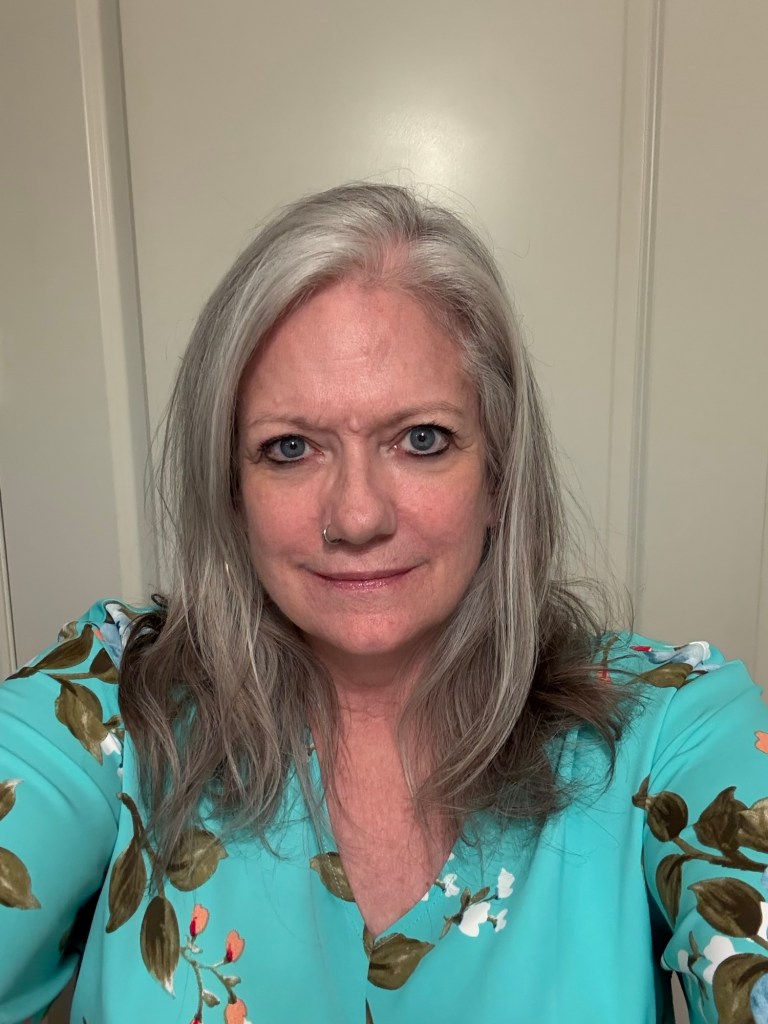
While all of these things are true, and sometimes they overwhelm my perception, it is also true that I am living my life. The picture in this post is of my husband and me celebrating our one month wedding anniversary. Several nights ago we took my daughter and her partner to dinner to celebrate their birthdays. We had a fabulous time! Good food, laughter, and delightful conversation. We cruise Costco or the mall. We watch movies. I drove twice this week. I love my life.

I know that I am fortunate. I know this is all a process and I just need to stay patient and engage in self care. I know a year from now all the parts that can will be behind me. I know that in this moment it’s still a lot some days.

A beautiful sunny day, a gentle breeze, and being content in the moment

I sit outside at a table with an umbrella on this cool, lovely, sunny morning. i’m wearing long yoga pants and an Oceanside sweatshirt that my daughter got me. Around my neck is a hummingbird necklace gifted to me by my son as I started this adventure. A breeze gently blows through my hair and caresses my skin. It’s good to be alive.

I’ve always believed that every day was a gift and on this journey, I am more convinced than ever that this is true. It’s also true that some moments are incredibly rough.

With all the accidents and injuries I’ve had in my life I thought I had a pretty good pain tolerance. That said, I was not ready for the pain involved in a breast cancer diagnosis, a double mastectomy, starting reconstruction, and just managing healing. There’s pain on so many levels, physical, emotional, spiritual (so many different types of physical pain). My identity feels squishy and somewhat nebulous, but I recognize that’s due to the moment I’m navigating. I am who I am. That will not change. I am strong. I am optimistic. I am independent. I am a warrior. To paraphrase the immortal words of Commander Taggart in Galaxy Quest, “(I) never give up and (I) never surrender.”

Some things happened this week that were frustrating and disappointing. My plastic surgeon decided that my expanders were still sitting too high in my chest, so he didn’t want to do my last full expansion this week. He only did half. And rather than planning for my reconstruction for two months from now, he wants to wait. Apparently if my expanders relax on their own, it’s a much simpler surgery. If they don’t, he has to deal with readjusting scar tissue, and the outcome, I guess, will be less positive. So I’m digging down and finding my patience to wait, to realize that I am just at the beginning stages of this whole process.

I have the most incredible support system. I am so blessed with family and friends who love me, who reach out to me, who provide expertise and information, who provide shoulders when I’m sad or overwhelmed. On this journey, whenever I have needed something the person who had the ability to provide, it has appeared. Breezy, one of my new daughters (by marriage) gifted me with a wonderful cushion vest that I can wear in the car to protect my chest from the seatbelt. Fortunately, for me now, she works at a bra spa and is helping me navigate the kind of support I need now that I don’t have to just use ace wraps any more. That whole concept has been overwhelming to me and having someone in my corner who is an expert is such a gift.

I’m just sitting here, pondering the idea that we can be underwhelmed and overwhelmed, but we can’t just be whelmed. I think I’d like to be whelmed for a while.

So on this beautiful Friday morning, I sit out by this lovely pool surrounded by palm trees and flowers, and I breathe, content in the knowledge that I am, content in the knowledge that I will be, content in the knowledge that I have all the resources I need to get through this. Thanks for listening!

Insights on communication and collaboration in my breast cancer journey: Part 1

A diagnosis of breast cancer is scary! I wrote the message below over a week ago, but thought the points of collaboration, responsive healthcare, openness about my concerns, in short, claiming my voice were important and might help others. So I decided to share it now.

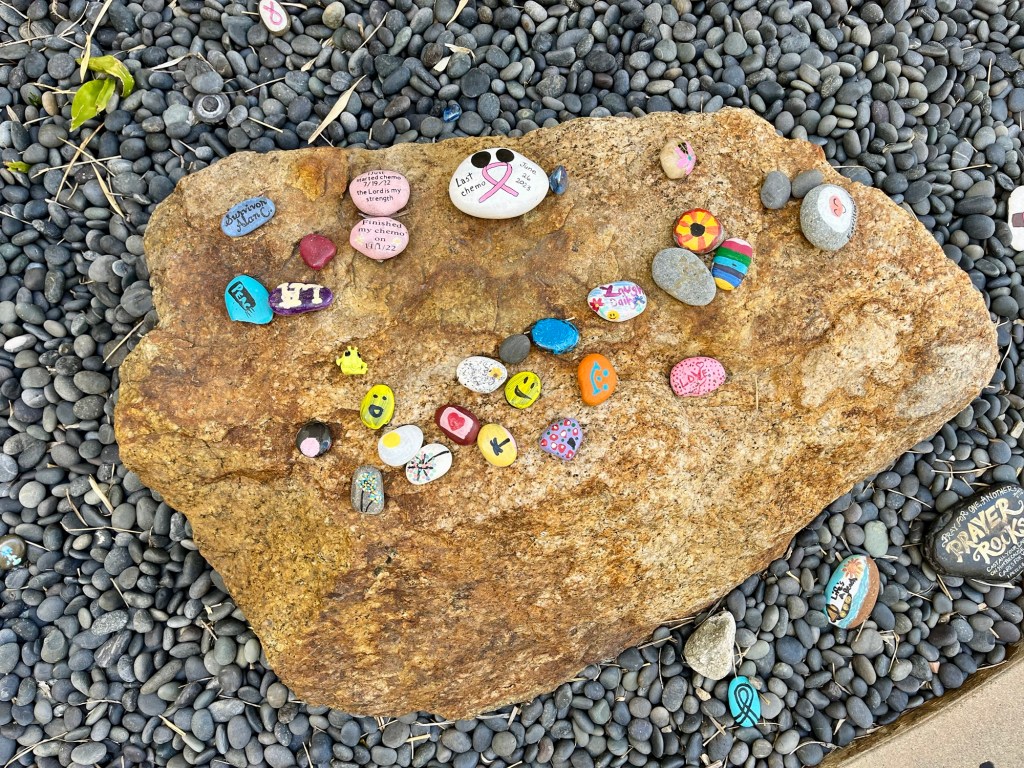
Providence St Jude rock garden

Today has been an interesting day. When we took a shower this morning my waterproofing around my right drain lifted and the padding underneath got wet, necessitating a call to my plastic surgeon. He thought Andrew and I could safely change it. Before we got the chance, my left drain inflated indicating an air leak. With 2 issues I felt we needed the doctor.

He met us at his office on a Saturday afternoon. He removed the packing and waterproofing on my right side, cleaned the area, then moved to the left side.

It took a while, but Andrew figured out that the effort to seal the slice in the tube leading to my drain (it was accidentally clipped as they were changing my dressings 2 days earlier) wasn’t working. The 3 of us then collaborated on a strategy to find and seal any leaks that included replacing the bulb and the stem on that side. This still didn’t do it, so Andrew posited that we needed to close the slice in the tube and tape it closed. I appreciated how collaborative my surgeon was in sorting everything out. In my experience, many physicians aren’t collaborative or creative problem solvers. Dr Lin is a wonderful exception. Once the leak was patched, Dr Lin instructed Andrew on how to manage both issues should they arise again and loaded us up with supplies just in case. Our goal was to keep the left drain working for another 1-2 weeks until it could safely be removed. The only alternative was to do a second surgery and replace the drain, an option we all hoped to avoid.

Then Dr Lin injected 120ccs of saline solution into each expander, bringing my total to 180ccs. The ultimate goal is 550-600ccs. (Since then I’ve reached 460 ccs.) Dr Lin thought this would both get us back on track and help reduce my fluid output. Our bodies create fluid to fill spaces and with more space taken up by the expanders, my body doesn’t have as much space to fill. This will hopefully facilitate drain removal.

I also talked with Dr Lin about his PA whom I really like, but who has also made a couple concerning mistakes, including clipping my drain tube. He set my mind at ease, and affirmed my perceptions. I then asked that he encourage trainees/interns to introduce themselves to patients when they enter rooms as a gesture of acknowledgement and respect. He thanked me for my feedback.

Here’s the interesting thing. I feel more grounded, more peaceful, and more myself today than I have to this point. I also feel more optimistic. It’s an awesome feeling.

I have an amazing medical team, an amazing support team, and I have this cancer situation. I know I will likely float in and out of this feeling of assurance and confidence, but I’m grateful for this feeling today.

A cancer diagnosis is an emotional roller coaster, as is treatment and follow up. But like any healthcare situation, openness, responsive, collaborative healthcare providers, asking questions, and claiming your voice are critically important to the success of treatment. I have more decisions coming up, so will have more to say on this topic. In the meantime, wishing you health and happiness.

Making peace with pain and a fire dragon

Before my double mastectomy, my doctors told me I wouldn’t feel much except for numbness in my chest. I’m happy to say that they were wrong. I’m also in a great deal of pain because they were wrong. Nerve pain is real, and apparently both the biopsy on my left breast and the mastectomy of my right breast did some nerve damage. Almost from the beginning, this pain had a form, the form of a red, burning fire dragon.

After I fell asleep at 1:30am, I don’t think I moved all night and when I woke up this morning, the entire fire dragon was flaming. Because the pain was excruciating, I felt motivated to try to figure out what my dragon – yes, I already think of it as “my” fire dragon – looks like.

Its head has gold/red lava eyes glancing out from my back languidly, slightly hooded, confident in its power. I don’t yet know if it’s female or male, or what it may wish to be called. These are details for later.

I just know that it’s taken up residence from my right scapula across my back, around my side and over my chest to my sternum from the left. Its body and tail stretch horizontally across my back. It is sleek and aerodynamic. Its wings tucked back along its sides and its legs drawn up against its body as if it has just dived from a high point, and is now smoothly gliding across a horizontal plane.

I do know that nothing seems to touch the red hot searing pain it causes when awakened. I try to let it sleep.

Images of many fire dragons show them breathing fire. Mine IS fire with golden and blue black tendrils of flame throughout its body.

In dragon lore, red fire dragons are proud, fierce, and vengeful. I have direct experience with those qualities. In Chinese culture, a red fire dragon symbolizes good fortune, happiness, and good luck. I hope that all these symbols are equally true.

I grew up reading the Dragonriders of Pern books by Anne McCaffrey. My little girl self yearned to impress on a dragon, making us partners for life. I may want to be more careful what I wish.

I’ve now taken pain meds and a muscle relaxer, and I’m more comfortable and a little more relaxed. Hoping to sleep. Rest fire dragon. Rest.

Reflections on Death and Dying: On the Importance of End-of-Life Conversations

End of life decision making is hard. End of life conversations are hard. They require, among other things, acknowledgement of the inevitability of death. In American culture, we are often not comfortable with that, even in the last precious moments.  I have had these conversations with my children since they were adolescents. They know if there is no hope I can be myself again, I don’t want any extraordinary measures taken. They know quality of life is more important to me than quantity of life. They know I wish to be an organ donor. They know I wish to be cremated. We have negotiated where my ashes will be spread when they’re ready to spread them. I hope that when the situation arises, this knowing will make things easier for them.

End of life is a personal matter for the person dying. It is also a community matter, a family matter, one that impacts and is influenced by loved ones who will be left behind. Dying happens in relationship, and the members of those relationships often have very different outlooks. In relationship, some are more or less ready to let go than others. Some are clearer on outcomes, more realistic about expectations. Some hope for miracles, that things are not as bad as they seem. Some hope that something can yet be done.  Some have strong beliefs and preferences. Health care providers are often less helpful than they could be about prognosis at these times, or, perhaps, loved ones hear, in providers’ words, what they have the ability to hear.

Death happens in relationship.

My father died over a decade ago. The memory of his last days is still as vivid today as it was then. For the last days of his life, all five of his children were by his side. My brother fixing things around the house, my sisters and I taking turns caring for Dad with in-home hospice support, all of us supporting Mom.

Because I could, it fell to me to have the end of life conversation with my Dad. Dad was already in hospice care, so extraordinary measures were no longer a question. What he wanted after death was. It was hard to make myself have this conversation. It felt final, like an acceptance of his inevitable passing. My heart hurt.  But I believed it was important. I believed that if he had desires, they should be honored if possible. I’m a crier at the best of times, and I didn’t want to cry when we had this talk. I finally decided that my crying didn’t matter and that I would do the best I could.

One afternoon, when he was having a good day, a particularly alert, pain-free moment, I climbed up on the bed next to him. “Dad, can I talk with you about something?”  I asked. “Sure, honey”, he said. “What would you like to have happen after?” I asked. He seemed surprised by the question. “After what?” he asked. “After you’re gone”, I replied, stroking his hair. “Would you like a funeral Mass? Would you like to be cremated or buried? Would you like to be buried here or in Westfield (Indiana, his birth home)?” “Do you think we need to talk about that now?” he asked. “We can… Or we can wait… Whatever you want…. I just wanted to offer you the chance to tell me if there’s anything particular you’d like.” “Well, I haven’t thought about it.” he said. I waited, quietly. “Well,… I asked Dick to be a pallbearer… So buried, I guess. I never thought about cremation… I don’t want to be far away from your Mom or Jennifer, so I think buried here is best… I’d like a 21 gun salute and the presentation of the flag at the cemetery. And I’d really like you to sing “Bridge Over Troubled Water” at the funeral. Aside from that, it’s up to you all.” “Dad, I don’t think there’s any way I’m going to be able to sing at your funeral.” I laughed. “I can be the lector at your Mass, though and do the readings. Would that be ok? I promise I’ll find someone to sing for you.” “Ok. I hope we don’t have to worry about this for a while yet”, he said. “Who do you want me to notify after you pass?” I asked. He listed family and friends, some old co-workers. “I think your Mom has all their numbers”, he answered. “Ok.” I said.

The first question was the hardest. As the conversation unfolded, each question got easier to ask. We got more comfortable talking with one another. We still held these issues in the realm of the future, even though it was clear that the future would not be long in coming. I snuggled into his side for a while longer. We were just quiet, together.

Later, I told my mother, sisters and brother what Dad had said. I asked if there was anything they wanted to have happen. I asked if anyone wanted to help me plan things. I made a list of who I needed to talk with and did some preliminary research on funeral homes. I talked with his parish priest and with people at the cemetery. We contacted the military to see what was needed in order to plan the 21 gun salute. We made a list of people we needed to call with phone numbers. I asked Mom who she wanted to call and who she wanted me to call.

When Dad passed, we moved quickly. This was not an easy time, but it was easier because we all knew Dad’s wishes and everyone had been able to have input into planning his funeral and burial. My task was simply to carry out my Dad and our family’s wishes to the best of my ability.

Having had this conversation in advance saved distress and disagreement after Dad’s death. Had we tried to make decisions then, without knowing his wishes, I am certain our heightened emotional state would have made things much more difficult. As it was, everything went smoothly and according to plan. I was lector for Dad’s funeral Mass and selected the readings myself. A young woman with a lovely voice sang “Bridge Over Troubled Water” as we left the church for the cemetery, where Dad received the requested 21 gun salute, and Mom was presented with the American flag.

Because death happens in relationship, end of life conversations are important. Not easy, but important. End of life conversations smooth the way for both the person passing and those left behind. Conversations that might not have happened otherwise can happen. Decisions that might be contentious later can be less so because the wishes of the person dying are known. I do not assume that all the conversations I have had with my children will prepare them for my death. I do not assume even that I will feel the same when the time comes that I do now. I do believe that we at least have a starting point for decisions, a roadmap should we never have the opportunity to revisit these topics.

In our culture end of life conversations are often awkward and uncomfortable. It helps if we can make them more routine. It makes it easier when we know a loved one’s wishes. End of life conversations protect the desires and preferences of the person dying and the feelings and relationships of those left behind.

The Florence Journals: Reflections on Death and Dying – Who am I in this Conversation?

When I started this writing journey in Florence, Italy, there were things I wanted to write and things I needed to write. This is the first of a series of posts that represent one topic from the latter list. They will deal with my perspective as a health communication scholar on end of life care, focused largely around my uncle’s death in 2013. This first post outlines how I came to this conversation personally and academically. I thought you should know from the outset, who I am in this conversation. For me, there has always been a strong relationship between the personal and the professional as you shall see. The following posts in this series will include academic critiques, personal narratives, and insights on how to negotiate end of life and advocate for self-determination and personal decision-making. 

In 1986, when she was 15 years old, my youngest sister was diagnosed with Acute Lymphoblastic Leukemia. She is a survivor who today is happily married with 4 children. That said, much of my sister’s battle with leukemia illustrated for me what is wrong with the US health care system. I had just developed my participative decision-making model for physicians and patients which would ultimately be published in 1990 (1) and in an expanded version in 1993 (2) when my sister was diagnosed.

As an academic, my first response is always research. So, when I flew to Florida to meet with my sister’s oncologist for the first time following her diagnosis, I was ready with questions about alternative treatments, success rates, the role of nutrition in enhancing her ability to overcome the cancer, treatment side effects, and so on. My first question after my sister’s oncologist outlined what I thought were his treatment recommendations was “What other alternatives do we have?” He replied, “You could leave.” That stopped me short. After a long pause, I replied, “I’m sorry. I don’t think you understood me. I’m asking what other treatment options are available for this type of leukemia.” He repeated, “None that I recommend, so if you don’t want to do what I advise, you are free to seek treatment elsewhere.” I was stunned. So much for collaborative decision-making. It quickly became clear that for my parents, there would be no options, no alternative treatments considered. This doctor was “the best”; they were going to put my sister in his hands.

I spent as much time in Florida with my sister as I could, traveling back and forth from Reno as my teaching schedule allowed. I remember on one trip, my sister asked me to play in the swimming pool with her. I used to be a pretty good diver. Back flips were my specialty. After doing several of those and making her laugh, she asked me to do a front flip. I don’t know why, but front flips have always been more of a challenge for me. I tried repeatedly over what felt like hours to do a front flip, stinging the backs of my legs a bright red. That night after dinner, we were snuggling in her bed and I quipped, “Well, since I clearly can’t do a front flip, what else can I do for you sweetie?” She said “Write about us. You’re the writer in the family. Write our story.” So I did. I interviewed my parents and my sister and I wrote their story. I didn’t include my voice as I wanted to empower theirs. I was “in and out”. I wasn’t part of the day to day. That journey was theirs. I co-authored what became a book chapter with my sister on her story and that of my parents. (3) I also wrote a companion chapter on the disenfranchisement of families coping with adolescent cancer (4).

In late 2001, my father became ill with what was diagnosed as terminal cancer. He was given 6 months to live. He died on June 27, 2002. My family was together for the last 2 weeks of his life and I took on the responsibility of talking with him about his final wishes and making arrangements for him. While not easy conversations, I think he appreciated my willingness to have them, including planning his funeral. The only things he wanted were to be buried in the local cemetery. He’d asked that his lifelong friend Dick be a pallbearer, and he wanted me to sing the Simon and Garfunkel song, Bridge over Troubled Water. Given the circumstances, I told him I knew I wouldn’t be able to sing. I did agree to do the readings at his funeral Mass though, and I was able to work through the church to find a young woman with a lovely voice who agreed to sing. The song was sung, my father’s wishes honored.

During those last two weeks, hospice was also with us around the clock. They were a blessing. They explained the dying process, what we could expect, choices we had to make, like allowing my father to stop eating, pain medications, etc. The only place we strongly disagreed and I could not win was over pain medication. As his condition deteriorated, the pain medications wore off more and more quickly. I spent the last 3 days of his life, until the afternoon of the day he died, on the couch in the living room next to his hospital bed. I dozed there and woke to administer his pain medications every 2 hours. When he dozed, I dozed. When he was restless or awake, I was awake. We talked. We held hands. I brushed his hair. I was there for him. The problem came in that I was not permitted to dose him more frequently than every two hours. Some of those two hour periods were brutal. For me, there was absolutely no reason for my father to feel any pain. I believed his pain medication should be “as needed”. For the hospice workers, the fear that he “might become addicted” held greater weight.

Shortly after my father’s death, I coauthored an article with Joyce Letner about centering families in communication research about cancer, outlining specific premises and strategies to support families in coping with cancer management (5).

You probably see a pattern here. My personal life often informs my academic work in health communication, or vice versa. While many other projects and lines of research over the next 10 years impacted my preparation to support my uncle and advocate for his wishes as he went through the process of dying in the summer of 2013, I was not fully ready. For this experience acting as his advocate, I have learned a great deal about negotiating end of life and health care decision-making which may be useful to others. I will write about those in future entries.

One important thank you. I am indebted to my colleagues at the Nevada Center for Ethics and Health Policy, at its height, a cutting edge think tank where medical, communication, public health, and theological experts brought their insights to bear on promoting advanced planning and quality of life decision-making at end of life. Through their inspiring work over years, I embraced more fully the notions of self-determination in health decision-making, the critical role of communication in health care, and patient empowerment. These insights served me well on this journey. So, I thank the kind, gentle, Reverend Noel Tiano, director of the center, and my insightful, brilliant colleagues who taught me the importance of advocacy, Drs. Barbara Thornton, Greg Hayes, and Craig Klugman.

Bibliography of my relevant publications referenced in the above:

  • Ballard-Reisch, D.S. (Spring, 1990).  A model of participative decision making for physician-patient interaction.  Health Communication.  2(2), 91-104.
  • Ballard-Reisch, D.S.  (1993).  Health care providers and consumers:  Making decisions together.  In B. Thornton and G. Kreps (Eds.).  Perspectives on Health Communication.  (pp. 66-80).  Prospect Heights, Ill: Waveland Press.
  • Ballard-Reisch, D.S. & Price, J. (1996). Separation and oncology: Copying strategies of a family dealing with leukemia. In E. Berlin-Ray (Ed.). Case Studies in Communication and the Disenfranchised. (pp. 75-86). Hillsdale, N.J: Lawrence Erlbaum and Associates, Publishers.
  • Ballard-Reisch, D.S. (1996). Coping with alienation, fear and isolation: The disenfranchisement of adolescents with cancer and their families. In E. Berlin-Ray (Ed.). Communication and the Disenfranchised. (pp. 185-208). Hillsdale, N.J: Lawrence Erlbaum and Associates, Publishers.
  • Ballard-Reisch, D.S. & Letner, J.A. (May, 2003). Centering families in cancer communication research: Acknowledging the impact of support, culture and process on client/provider communication in cancer management. Patient Education and Counseling, 2074, 1-6.