The Florence Journals: Reflections on Death & Dying – The Beginning of the End of SOB (Sweet Old Bill)

On July 4, 2013, Bill declared his independence. In the early 2000s, he’d had a kidney transplant. Aside from that, he was an extremely healthy 84 year old. As with most older adults, in the United States, though, he was on multiple medications to manage multiple minor chronic issues. That’s really context for our story. Approximately a year and a half earlier, after his wife’s death, a series of minor mishaps, literally missteps, started the journey that would lead to his declaration. He needed to have several toes removed due to poor circulation, causing significant mobility issues. Recovering from this, he contracted a virus that put him to bed for several weeks. When he was well again, he was extremely weak and needed to build strength to walk again. He got to the point where he could use a walker or a cane to haul his 6 foot 6 inch frame around, and ultimately take several steps unaided. However, his strength and vigor did not return. This frustrated Bill, an extremely independent man.

One evening he stepped on something sharp. He couldn’t see or feel what it was, but his foot bled profusely. His neighbor and good friend Dino, who had been his support person, particularly with activities of daily living, would be over the next morning to assist him, so Bill just put on a Depends, wrapped his foot in a towel and went to bed. The following morning, Dino found him this way, blood soaked towel wrapped around his injured foot, soaked Depends, his friend needing assistance. Dino cleaned Bill up as best he could, washing him, slathering his foot with antibiotic ointment, and bandaging his foot. The bleeding had stopped by then. Dino made Bill breakfast. Bill, not being one to lie idly by, fussed and grumbled about not being able to get around, but Dino persuaded him to stay in bed that morning and give his foot a rest.

The next day, Bill was still in pain and couldn’t put weight on his foot; Dino cleaned and re-bandaged it for him. This happened the next day and the next and the next, until the fifth day when Bill awoke with a fever and Dino recognized that Bill’s foot was infected. Dino called an ambulance to take Bill to the hospital.

Whether the toe removal, the virus, the item Bill stepped on that led to the infection, or the spiral of medical issues set in motion at the hospital when Bill arrived for treatment for his foot were singularly or collectively the last straw, for those who knew him, Bill’s July 4 declaration of independence quickly became a predictable conclusion. Bill was a proud man, an independent man. He’d been in the medical corps during the Korean War. He was not comfortable relying on others.

At the hospital, an inexperienced physician disregarded the information that Bill had had a kidney transplant and prescribed an antibiotic that disrupted his kidney functioning. He told Bill he was sorry, but they would need to do minor surgery to repair the damage. Bill took matters into his own hands, requesting a psychiatric consultation. After a 45 minute consultation, Bill asked the psychiatrist if she thought he was competent to make his own medical decisions. She responded “Absolutely!  I have no questions at all about your competence. Why do you ask?” Bill replied, “Because as of today I am taking myself off all my medications. I am also refusing this surgery to repair the damage caused to my kidney by the antibiotics and I don’t want anyone to be able to challenge this decision. Now, please get a piece of paper, we’ll write out each of my medications. I will sign that I refuse to continue them and you will sign that I am competent to do so”. Surprised, the psychiatrist did as Bill requested.

Bill remained calm and resolute as several medical professionals tried to talk him out of this decision. He was done with medical care. With signed paper in hand and fresh advanced directives and against his doctor’s advice, Bill was wheeled out of the hospital. His trusty friend Dino was there to take him home. Bill believed that he would die quickly as he thought that taking himself off the anti-rejection medication for his kidney would lead to his body rejecting the kidney, causing it to shut down. He believed he would die quickly and painlessly. That was not to be the case.

When Bill left the hospital, he believed he was going home to die. His two friends Dino and Kenny disagreed with Bill’s decision and it took him several days to bring them around to at least understanding his way of thinking. Once they were grudgingly on board, Bill called me, his niece, and told me of his decision. I listened quietly. We both shed a few tears. I told him I loved him and would miss him, but that I would fight for his right to decide. Neither of us knew what this would ultimately involve. But our trust and commitment to one another, and to Bill’s right to make this decision, strengthened our resolve to face whatever came next.

Bill got his affairs in and went to bed to wait.
A Love Letter to My Son on the 2nd Anniversary of the Dancing Accident that Broke My Wrists

We wish things for our children before they are born. In my case, I wished that my children would be loving, strong in character, and independent. My son and daughter are all these things in very different ways. This love letter, though, is to my son. Often we don’t get to see the full measure of who our children become. As they grow, they live their lives more and more separate from ours. I got the opportunity to see my son for the man he is. It is an opportunity I will always cherish.

Stefan

On October 13, 2012, our lives changed. Stefan was in Wichita, Kansas visiting me before joining the Navy. He was preparing for boot camp and contemplating signing his final admittance paperwork. I was at my favorite academic conference of the year, the place where I have found both my creative inspiration and my best friends. This year the Organization for the Study of Communication, Language and Gender Conference was held in Tacoma, Washington.

That fateful day was perfect. I walked the city streets exploring and shopping for gifts for family and friends. In the late morning and afternoon, I attended research panels and communed with friends and colleagues. At the awards banquet, I was awarded the prestigious Feminist Teacher / Mentor Award based on letters of support from dozens of colleagues, students, and former students. This is the most treasured honor of my academic career. To top it all off, I was selected to host the induction ceremony of Dr. Bren Ortega Murphy into the Wise Women Council. This day was without question, one of the highpoints of my academic life.

Later that evening, following dinner with some of my best friends, the organization sponsored a dance and karaoke party. I love to sing and dance. Could this day get any better? As fate would have it, my best academic day also became the start of one of the most challenging adventures of my life. On the dance floor that evening, one of my best friends spun me around. I reeled backwards, lost my footing and fell, fracturing my right wrist in 3 places, and my left in 2.

I would be fully immobilized for the next 3 months and slowly and painfully thereafter, learn to use my hands again. My convalescence, during which I needed constant around the clock support, was 6 months. Even after that, there were some things I still couldn’t do, open jars, cut meat, negotiate some articles of clothing, etc.

My motto has long been that you can view any situation as a crisis or an adventure and that not very many things rise to the status of a crisis. These events allowed me to put this belief into action, to try to live it under some of the most challenging circumstances I could imagine. My belief has not changed, but I have learned to recognize the critical role others can play in making it a reality. Because of the love and care of my son, breaking both my wrists, being completely helpless, and learning how to use my hands again was not a crisis. It was an adventure. I have written in earlier posts about the trip back to Wichita, about losing my graduate students and making the trip alone, about the scary woman who thought I needed hot coffee, about my seatmate and later a flight attendant who took care of my hair for me, about the young basketball star, traveling with her parents to Wichita State University to check out the school, who fed me and gave me pain medication.

I have not written about my son, about our adventure. Maybe because it was so big, so all encompassing. It wasn’t time bound like 2 plane flights. It was day-to-day for over 6 months. It was emergent with no set ending that we were aware of. During this time, my insurance company told me on multiple occasions that because I could walk, I was considered too mobile for any in-home nursing support. This, despite the fact that I could not use my hands at all and therefore could not accomplish any activities of daily living on my own. My 24/7 care fell to my son.  There was never really a conversation about his doing this. He just smoothly moved into the role of my nurse and full-time caregiver.

I remember very little about the early days. To manage my excruciating pain, I was in a drug induced haze much of the time. I do remember my son giving me pain medication, brushing my hair, helping me to the bathroom, feeding me, and a myriad of other little things, none of which I could do for myself. I remember him being there when I needed something, often before I realized I needed it. In those early days, we developed a routine and designed our own ways of managing sensitive issues. Taking care of someone completely requires suspending modesty. It requires an unparalleled level of intimacy. It can be a humiliating experience, an embarrassing experience, an uncomfortable experience. Because of his grace, it was never humiliating or embarrassing. and we developed work arounds for the uncomfortable parts.

There’s something you should know about me. While it is easy for me to help others, it has always been hard for me to ask for help. While I never see those I help and support as burdens, for some reason, I believe (believed) that if I needed help I was an inconvenience, a burden. Through his compassion and care, my son showed me that this was not the case. He made it ok that I needed support. He showed me that I was not a burden, an inconvenience. He showed me that he was glad to help me.

Once the drug haze wore off a bit and my pain became more manageable, I could think for several hours at a time between doses of pain medication, and I wanted to get back to work. I was still teaching a class (fortunately I had 4 weeks of guest lecturers lined up prior to the accident) and running the search for our new director at the Elliott School of Communication. Stefan policed me to make sure I didn’t work too hard. We both learned that if I did too much too fast, I would pay in pain and exhaustion. He limited people’s access to me, determining when and for how long my graduate students and friends could come work with me. We identified what he was willing and comfortable doing and what I needed to ask others to do. He didn’t like emails or any work related phone calls, so my graduate students and friends helped with those.

On Thursdays he would get us Buffalo Wild Wings, mango habanero and Asian zing boneless wings that set my mouth on fire. We would eat them propped up on my bed, him feeding me. For a lot of the early months, I was mostly bedridden. Because of my multiple fractures, and to avoid surgery, I was not permitted to move much as my wrists healed. Eventually I was put in casts and I could move around a bit more. During my immobile time, we watched the entire series of Third Rock from the Sun on Hulu+. Sometimes if my pain was too bad, we would watch episodes over and over until I was alert enough to remember them. As I got more alert, it became clear to me that Stefan needed breaks. With some coaxing, he would take some down time when friends would bring meals and stay to chat and feed me. Eventually, he let friends take me to their home for the weekend so he could get some real time off. He was very protective, but we both knew he needed that time.

What I remember most about this time is my son’s presence. He was just there with me. We had few disagreements. The biggest was over his putting mascara on me. “You don’t need it. You’re beautiful without it”, he’d say. “Yes I do. I’d put it on myself if I could”, I’d reply. “I’ll poke your eye out”, he’d say. “No you won’t”, I’d reply. Then he’d help me with mascara.

I don’t believe that Stefan or I are the same people we were before this experience. To be helpless is not easy. To be completely reliant on someone else for everything is not easy. To be completely responsible for another is not easy. To negotiate this type of situation with love and compassion, with presence and commitment, is an incredible gift. To make it an adventure that we grew through together was the most amazing part of this experience, and our relationship will never be the same.

I think that we are both stronger, better prepared to deal with whatever life sends our way. I am easier, more open to asking for help when I need it. He knows his strength and the depth of his compassion. I am more grateful to my son than I can put into words. He made me safe. He loved me. He nurtured me and he treated me with compassion and respect during my helplessness. I learned firsthand that he is compassionate, thoughtful, intuitive, and very kind. He has a calm, peaceful spirit. Not much seems to faze him. He is an incredible man and his strength of character puts me in awe and fills me with joy. He is the most amazing man I have ever known, and I am blessed that he is my son.

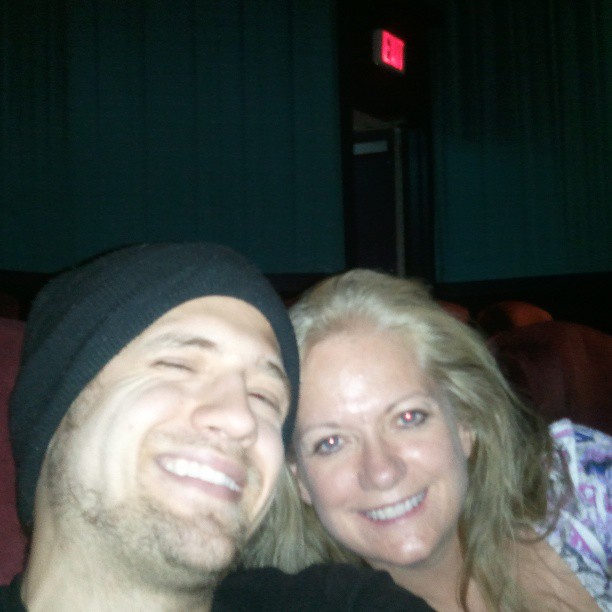
Stefan and me 3

Stefan and me 2

The Florence Journals: Reflections on Death and Dying – Who am I in this Conversation?

When I started this writing journey in Florence, Italy, there were things I wanted to write and things I needed to write. This is the first of a series of posts that represent one topic from the latter list. They will deal with my perspective as a health communication scholar on end of life care, focused largely around my uncle’s death in 2013. This first post outlines how I came to this conversation personally and academically. I thought you should know from the outset, who I am in this conversation. For me, there has always been a strong relationship between the personal and the professional as you shall see. The following posts in this series will include academic critiques, personal narratives, and insights on how to negotiate end of life and advocate for self-determination and personal decision-making. 

In 1986, when she was 15 years old, my youngest sister was diagnosed with Acute Lymphoblastic Leukemia. She is a survivor who today is happily married with 4 children. That said, much of my sister’s battle with leukemia illustrated for me what is wrong with the US health care system. I had just developed my participative decision-making model for physicians and patients which would ultimately be published in 1990 (1) and in an expanded version in 1993 (2) when my sister was diagnosed.

As an academic, my first response is always research. So, when I flew to Florida to meet with my sister’s oncologist for the first time following her diagnosis, I was ready with questions about alternative treatments, success rates, the role of nutrition in enhancing her ability to overcome the cancer, treatment side effects, and so on. My first question after my sister’s oncologist outlined what I thought were his treatment recommendations was “What other alternatives do we have?” He replied, “You could leave.” That stopped me short. After a long pause, I replied, “I’m sorry. I don’t think you understood me. I’m asking what other treatment options are available for this type of leukemia.” He repeated, “None that I recommend, so if you don’t want to do what I advise, you are free to seek treatment elsewhere.” I was stunned. So much for collaborative decision-making. It quickly became clear that for my parents, there would be no options, no alternative treatments considered. This doctor was “the best”; they were going to put my sister in his hands.

I spent as much time in Florida with my sister as I could, traveling back and forth from Reno as my teaching schedule allowed. I remember on one trip, my sister asked me to play in the swimming pool with her. I used to be a pretty good diver. Back flips were my specialty. After doing several of those and making her laugh, she asked me to do a front flip. I don’t know why, but front flips have always been more of a challenge for me. I tried repeatedly over what felt like hours to do a front flip, stinging the backs of my legs a bright red. That night after dinner, we were snuggling in her bed and I quipped, “Well, since I clearly can’t do a front flip, what else can I do for you sweetie?” She said “Write about us. You’re the writer in the family. Write our story.” So I did. I interviewed my parents and my sister and I wrote their story. I didn’t include my voice as I wanted to empower theirs. I was “in and out”. I wasn’t part of the day to day. That journey was theirs. I co-authored what became a book chapter with my sister on her story and that of my parents. (3) I also wrote a companion chapter on the disenfranchisement of families coping with adolescent cancer (4).

In late 2001, my father became ill with what was diagnosed as terminal cancer. He was given 6 months to live. He died on June 27, 2002. My family was together for the last 2 weeks of his life and I took on the responsibility of talking with him about his final wishes and making arrangements for him. While not easy conversations, I think he appreciated my willingness to have them, including planning his funeral. The only things he wanted were to be buried in the local cemetery. He’d asked that his lifelong friend Dick be a pallbearer, and he wanted me to sing the Simon and Garfunkel song, Bridge over Troubled Water. Given the circumstances, I told him I knew I wouldn’t be able to sing. I did agree to do the readings at his funeral Mass though, and I was able to work through the church to find a young woman with a lovely voice who agreed to sing. The song was sung, my father’s wishes honored.

During those last two weeks, hospice was also with us around the clock. They were a blessing. They explained the dying process, what we could expect, choices we had to make, like allowing my father to stop eating, pain medications, etc. The only place we strongly disagreed and I could not win was over pain medication. As his condition deteriorated, the pain medications wore off more and more quickly. I spent the last 3 days of his life, until the afternoon of the day he died, on the couch in the living room next to his hospital bed. I dozed there and woke to administer his pain medications every 2 hours. When he dozed, I dozed. When he was restless or awake, I was awake. We talked. We held hands. I brushed his hair. I was there for him. The problem came in that I was not permitted to dose him more frequently than every two hours. Some of those two hour periods were brutal. For me, there was absolutely no reason for my father to feel any pain. I believed his pain medication should be “as needed”. For the hospice workers, the fear that he “might become addicted” held greater weight.

Shortly after my father’s death, I coauthored an article with Joyce Letner about centering families in communication research about cancer, outlining specific premises and strategies to support families in coping with cancer management (5).

You probably see a pattern here. My personal life often informs my academic work in health communication, or vice versa. While many other projects and lines of research over the next 10 years impacted my preparation to support my uncle and advocate for his wishes as he went through the process of dying in the summer of 2013, I was not fully ready. For this experience acting as his advocate, I have learned a great deal about negotiating end of life and health care decision-making which may be useful to others. I will write about those in future entries.

One important thank you. I am indebted to my colleagues at the Nevada Center for Ethics and Health Policy, at its height, a cutting edge think tank where medical, communication, public health, and theological experts brought their insights to bear on promoting advanced planning and quality of life decision-making at end of life. Through their inspiring work over years, I embraced more fully the notions of self-determination in health decision-making, the critical role of communication in health care, and patient empowerment. These insights served me well on this journey. So, I thank the kind, gentle, Reverend Noel Tiano, director of the center, and my insightful, brilliant colleagues who taught me the importance of advocacy, Drs. Barbara Thornton, Greg Hayes, and Craig Klugman.

Bibliography of my relevant publications referenced in the above:

  • Ballard-Reisch, D.S. (Spring, 1990).  A model of participative decision making for physician-patient interaction.  Health Communication.  2(2), 91-104.
  • Ballard-Reisch, D.S.  (1993).  Health care providers and consumers:  Making decisions together.  In B. Thornton and G. Kreps (Eds.).  Perspectives on Health Communication.  (pp. 66-80).  Prospect Heights, Ill: Waveland Press.
  • Ballard-Reisch, D.S. & Price, J. (1996). Separation and oncology: Copying strategies of a family dealing with leukemia. In E. Berlin-Ray (Ed.). Case Studies in Communication and the Disenfranchised. (pp. 75-86). Hillsdale, N.J: Lawrence Erlbaum and Associates, Publishers.
  • Ballard-Reisch, D.S. (1996). Coping with alienation, fear and isolation: The disenfranchisement of adolescents with cancer and their families. In E. Berlin-Ray (Ed.). Communication and the Disenfranchised. (pp. 185-208). Hillsdale, N.J: Lawrence Erlbaum and Associates, Publishers.
  • Ballard-Reisch, D.S. & Letner, J.A. (May, 2003). Centering families in cancer communication research: Acknowledging the impact of support, culture and process on client/provider communication in cancer management. Patient Education and Counseling, 2074, 1-6.

The Florence Journals: Exploring the 15th International Ceramics Fair

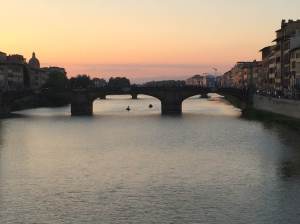
Sunset on the Arno 10 4

Sunset on the Ponte Vecchio

I write to you at the end of an absolutely beautiful, warm, autumn day. It was sunny, but not too hot and there was an almost constant gentle breeze blowing. It was the perfect first day of the 15th International Ceramics Fair in Piazza Annunziata. It also runs tomorrow from 10-7. Sponsored by the Arte della Ceramica, the fair began in 2000 as a venue for ceramic artists from throughout Europe to show and sell their work. This year the fair includes 68 ceramic artists from Austria, France, Germany, Italy, Spain, and Slovenia.

In this post, I will simply let the beauty of the artwork speak for itself. These are just a few of my favorites.

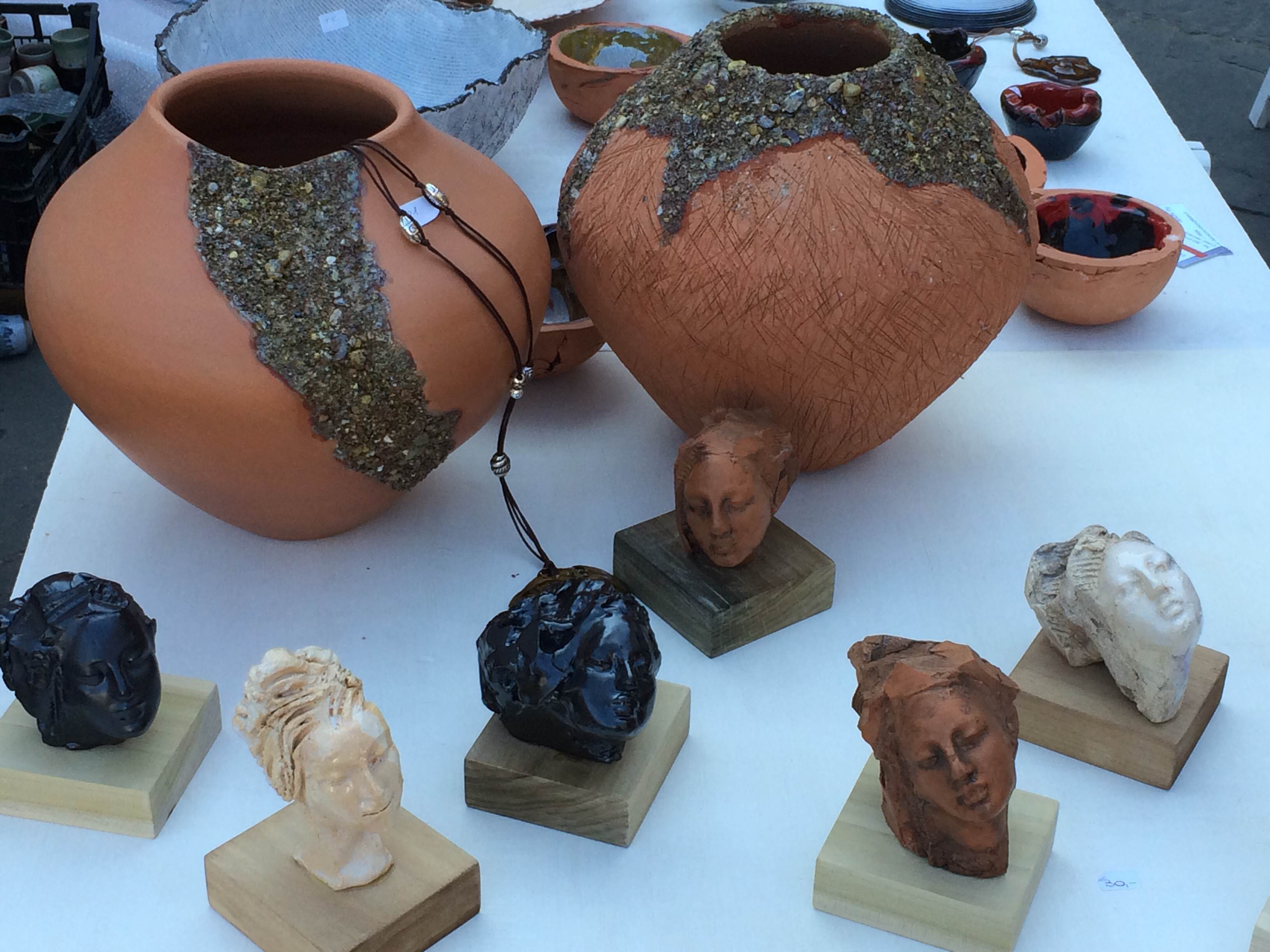
Brown with river rock

Lovely earthenware vases accented with river rock by Vinicio Barcaccia of Italy. barcaccia.vinicio@libero.it

Blue Raku

Beautiful raku pottery by Christina Perrin of France. christine.perrin80@sfr.fr.

Love letters

Ceramic love letters by Catia Clinaz of Italy http://www.cuoriditerra.it

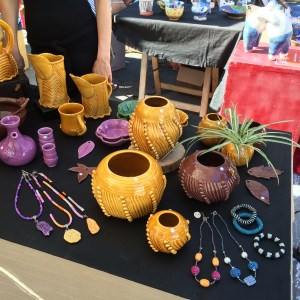
Emma work

Colorful pots and jewelry made by Emma Draghi of Italy – http://www.emma.draghi.com

Poetry

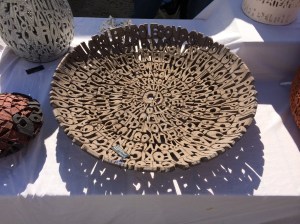
Poetry in pottery – art made out of the sentences, phrases, poems by Nicole Grammi of Italy – http://www.potterynicole.com

There are so many more examples I could show! The variety and creativity are impressive. While I generally take more general photos at events, today I wanted to feature the actual work of some of these artists and to do so, I gained their permission and credited them directly for their creations. The intellectual and creative property of an artist is her or his ideas made manifest. It is delightful to be able to share some of their genius with you.

The Florence Journals: Reflections on Connection and Child Birth

On September 22, 2014 my friend Andrew’s oldest daughter had her first child, a son. While this is his fourth grandchild, he is the first I’ve been around for. If, by around, I mean thousands of miles away in Florence, Italy. Since Tiffany went into labor, I’ve reflected a lot on pregnancy, labor, and birth. I remember when I was pregnant with Stefan, hearing the lyrics to the song “The Story Goes On” from the musical Baby. They had a profound impact on me.

“And all these things I feel and more
My mother’s mother felt and hers before
A chain of life began upon the shore of some primordial sea has
stretched through time and reached to me
And now I can see the chain extending
My child is next in the line that has no ending
And here am I feeling life that her child will feel when I’m long gone

Yes all that was is part of me as I am part of what’s to be
And thus it is our story goes on
And on and on and on and on”

I was overcome with emotion when I heard this song.  I spread my hands across my body, amazed both by the precious life I was carrying and the realization that I was where every woman who had ever carried a child had been. Every mother in history had shared the waiting. Some had shared the uncertainty, the fear. Some had shared loss. Ultimately, all the women in my line had known the reality of bringing forth new life, some into contexts of privilege, some into pain. Some precious lives were cut short. Some were long and fruitful. But the chain from those women, my kin, was unbroken through time to me. Mother to mother to mother to mother for countless generations, and now, I was carrying the line forward. And now I was on the brink of becoming a mother. It felt overwhelming, but also calming to recognize the long line of women who had gone before me, whose lives led me to this point. I also felt hopeful for all the women who might come after me, continuing the line of women birthing children.

I felt a strong connection to my mother, to her mother. I called my mom to share these lyrics, these feelings with her. We cried. We laughed. We talked for hours. Our connection strong. We had a common understanding that I was carrying into the future.

Today I wish for Tiffany this joy of connection, of realization, of awareness of all who have come before and her contribution to all who will follow.

  • Baby is a musical with a book by Sybille Pearson, based on a story developed with Susan Yankowitz, music by David Shire, and lyrics by Richard Maltby, Jr. It concerns the reactions of three couples each expecting a child. The musical first ran on Broadway from 1983 to 1984.

The Florence Journals: On Social Media and being an Extrovert in a Foreign Land

So, dear reader, as you know, I’m in Florence, Italy.

Florence

Just to clarify, I don’t speak Italian, although I can carry on a very thorough conversation about that, in Italian. (Rant: I have no idea why language programs teach inane information first. And I have found this to be true with every language program I’ve ever used (Spanish, Italian, Russian). I’ve just done 3 lessons on Pimsleur on being able, or not being able to, understand Italian or English and to ask people if they are Italian or American. I don’t have those conversations! All I need from that is one line! “I don’t understand”. (Non capisco). My first lessons on Rosetta Stone were about reading, swimming (really!!!) eating and drinking (ok, those were somewhat useful). However, when I go into a restaurant to eat or drink, I don’t generally find myself needing to broadcast that. It seems self-evident. I’m sure I’ll get to useful language at some point. (But, I digress.). (One more quick sidenote: I’ve found the translator on the app TripLingo, http://www.triplingo.com, to be extremely useful when wifi is available).

I also don’t know anyone here. So, I stroll the Ponte Vecchio and tourist hangouts in the evenings so that I can meet and speak with people. I’ve found it surprising how many English and Russian speakers I’ve met here. I seem to do pretty well in both languages and with maps and hand gestures have been able to carry on some pretty interesting conversations. I’m not sure why, but my Russian seems to improve in countries where English is not the first language.

That’s all well and good. In fact, I chose Florence because I didn’t know the language, because I didn’t know anyone, and because I fell in love with the city when I first came here almost two decades ago. I’ll continue to learn Italian. I’ll continue to put myself in situations where I have the opportunity to meet people. However, I am currently in a “between time” and I find it insightful. I am an extrovert without the ability to interact very much.

I suppose it’s not surprising then that social media is kind of a lifeline here for me. As an extrovert (and if I ever had any doubts, I don’t now), I NEED interaction with others. In fact, I’m not just an extrovert. On the Myers-Briggs test I score as an ENFP (extrovert, intuitive, feeling, perceiver). I am described as an “enthusiastic, creative, and sociable free spirit, who can always find a reason to smile”. Here are my results: http://www.16personalities.com/enfp-personality. I won’t go into that further here, but if you read the report, you might see why I react to this situation as I do.  If you’re interested in how you score, check out the free test here: http://www.16personalities.com. I was certified in Myers-Briggs years ago and taught it numerous times to classes of U.S. judges as well as American college students. It’s interesting stuff. (But, again I digress.).

Even though I’m an extrovert, I also need to disconnect sometimes and pull inward. That is the purpose of this trip, to claim some down time, to reflect, to think, to plan. Interestingly, I have found myself at times feeling isolated. It occurs to me that the possibility of connection, as a way of not feeling isolated, is extremely important to me. Not to overstate the obvious, no matter how interesting and life affirming living in a foreign country is, it can, at times, be lonely, especially if one doesn’t know anyone, or speak the language. So, to come around again, I am grateful for the internet, for my ability to connect with family and friends through Skype, FaceTime, text messaging, Facebook, Twitter, my blog, your blog, etc. On days when I don’t feel well, or when I can’t sleep, or when it’s raining too hard for me to want to venture out, I’m on here a lot. It helps me to feel connected. It helps me feel less isolated.

I think the researchers who decry the internet as the ruin of personal relationships have it wrong. The internet has the potential to allow us to interact with, to care about, to build relationships with, to strengthen relations with, and to share care with people in ways we would not be able to otherwise. I think what we are seeing is kind of a revolution in relationship that is enhanced by social media in all forms. (I plan to write more on this later and have, in fact, researched this, in an academic sense).

View from my window 2

This is where I write: View from my window

There are other characteristics of my being an extrovert and other insights I’ve learned in my 2 weeks here that I will share in later posts. But for now I would like to leave you with a big THANK YOU!!!!! Your engagement on social media helps me feel connected in this “between time”, and that is a real gift to this extrovert.  Ciao!

The Florence Journals: On Writing and Reluctance

I’ve had some interesting insights into myself since I arrived here in Florence, Italy a little over a week ago.

This is the first entry about those insights. In my journal, I’ve noted that I’m aware of the possibility that someone else might read my words and I find myself silencing or editing myself because of the risk that my words might be judged, evaluated. I don’t necessarily intend to share my journal writing with anyone. I may edit writings for blog posts, like this one. But I’d like what I write in my journal to be for me, to be free of any “generalized others”, any audience that may read and draw conclusions. (Yes, I hear the echos of Kenneth Burke and George Herbert Mead in what I’ve written.) I desire to work on this.

As I revised my journal writing for this blog post, I had an insight. I know where this concern came from. Like all teenagers, my life had a degree of angst. I used to journal all the time. I can still picture the spiral notebook in which I wrote. The peach and pink swirls on the cover. I loved that notebook. I wish I could still picture the words.

One day, while I was in 8th grade, the principal, a very serious nun I did not particularly like or trust (She was one of those people who could make any information fly out of my head simply by asking me a direct question.) had a fellow student call me out of class to go to her office. That was never a good sign. In 8th grade, it typically meant our cheerleading skirts were too short (Yes, I was an 8th grade cheerleader) and we were going to have to kneel on the floor and have them measured with a ruler.

This time was different. I walked into her office and she just looked at me. Eventually, I felt myself squirming. However, we didn’t speak until spoken to, so I just waited. Finally she asked me to take a seat across from her desk. This never happened. No one sat down in her office. I sat nervously, wondering what I had done, what she wanted, what was wrong… A million thoughts flew through my head.

She opened with “So, I understand you like to write”. I was startled. I had no idea what she was referring to. I replied, “Yes, I guess”. “Well, do you or don’t you?”, she asked pointedly. “Yes”, I stammered, more of a question than an answer. “So, what is this?”, she asked picking my journal up from her desk. I panicked and froze. “It looks like my journal. How did you get my journal?!”, I whimpered. I had written my most personal thoughts in that journal. It was not for anyone else’s eyes. “You’re a very good writer. Keep writing” she stated, “Now go back to class”.

Shaking, I took my journal from her hands and left. Rather than feeling supported, as my optimistic self believes she probably intended, I felt betrayed. I felt rage! What gave her the right to read my journal, to read my private thoughts? And how did she get it anyway? I never got answers to these questions. On my way to class, I made a detour to the incinerator in the basement. I tore my journal to shreds, feeding page after page into the fire, last of all the peach and pink swirled cover. I watched as the flames licked it black and it turned to ash. When I was done, I walked, still shaking, back to my classroom. I have no idea what we studied that afternoon. I know only that I felt relief. No one could ever again read my private words. Often when I saw her in the hallway after that, she’d stop me and ask “Still writing”? I’d just smile. I’d stopped writing.  I stopped writing… for a long time.

Now, many years later, I would do almost anything to be able to read the words in that peach and pink notebook, to have access to those thoughts, to know what my younger self pondered, questioned, explored. Something precious was lost that day. While I can’t get her words back, perhaps I can learn to claim mine again, on paper, as I did then, so that one day, my older self will know me through my words. Or, maybe some other reader who cares to know who I was will read them. I hope that I, she, he will hear through my words the real, unedited me, not a redacted or silenced me. I hope they will see me in all my shades and passions, the angst and joys that I experience. That is my hope. We will see.

The Florence Journals: Reflections on Visioning, Career, and Multi-Tasking

So friends, I’ve been in Florence, Italy for 1 week. I’ve been a professor my entire (post undergrad) working life. I have loved it. I have lived my passion. I have grown, developed and shifted my interests throughout my career. I have become achingly aware of the fact that in moving at the speed of light it may, at times, be difficult to do several things: 1) acknowledge the accomplishments which will help feed future work, dedication, and commitment, 2) plan for the future – I don’t know about you, but I typically spend so much time on the “fire of the day” that feeding my own passion happens less than I would like. Don’t get me wrong. I DO feed my passions. I just sometimes get caught up in the demands of the moment and attend to them less than I might like. I also realized recently that I don’t make long term plans any longer. For years, I had 5 year plans. That changed when I was promoted to full professor. Then my strategy shifted to taking whatever “cool” opportunities came my way. Opportunities had to most importantly 1) benefit my students and/or 2) allow me to work consistently with my beliefs and values. The best projects did, and still do, both. I refused to do anything that was not consistent with my beliefs and values.

More and more, that has meant grant funded work that emphasizes community-based participatory research, specifically, working with communities to help them identify issues of interest to them and maximize their outcomes. That said, sometimes that has also meant taking the money for the students rather than the passion. These strategies have found me working over the past decade in public health preparedness (my first foray into CBPR); identifying barriers for minority populations of accessing help in paying utility bills (one of the most insightful projects I’ve ever undertaken), while at the same time helping the utility provider improve their reputation following a disastrous stint with ENRON; health promotion for older adults in rural and frontier areas of Kansas; community-based decision making around wind energy; working with an interdisciplinary team to create a toolkit to help older adults in a Kansas County to reduce falls called Falling LinKS  http://webs.wichita.edu/?u=AGING&p=/FallingLinKS/Page1/, and hunger awareness and activism. Perhaps my most fulfilling work over the last decade has been launching the Hunger Awareness Initiative as Wichita State University. You can find us on Facebook at: https://www.facebook.com/WSUHungerAwareness, on Twitter at @WSUHunger or #WSUHunger, and visit our website at: https://wsuhunger.wordpress.com.  I wrote earlier about what got me into the hunger space: https://dballardreisch.wordpress.com/2011/10/04/who-am-i-on-this-hunger-awareness-journey/. I have a number of blog posts on this issue, but this is my “Who am I?” post.

3) I have also recognized that none of us do “this” the same way. There is a great deal of writing, thinking and lamenting on the downside of multi-tasking at the moment. I could not disagree more! Multi-tasking is not a myth and it is a godsend for those of us who think 24/7 and who are highly productive. (I plan to write more on that later, but for now, suffice it to say, we are all differently abled. Somehow we have lost track of that in recent years and anything that is not “normal” has become problematic. I would argue that there is no such thing as “normal” and that striving to be so keeps many of us from recognizing our unique gifts – but I digress.) That said, even the best multi-taskers might at times need to take a break and just “be”, just reflect, plan, breathe. That is, among other things (I AM a multi-tasker after all), what I am doing on this sabbatical.

While I love my life and my career, I also have a strong desire to do something different. I have no idea what that will be. I do have faith that I will find “it”.  On September 2, 2014, my first full day in Florence, serendipity stepped in and I met a woman I wrote about in an earlier post, Lauren Haas, who 1-1/2 years ago sold everything she owned to become a traveling writer. She takes gigs that pay $30-$150 which generally have nothing to do with where she’s living, and she travels the world. How cool is that?! Her adventure reminded me of this cartoon. I love meeting people who are following their dreams! http://www.filmsforaction.org/articles/what-if-money-was-no-object/

I’m not yet sure what my next dream will be, but for now the streets of Florence beckon, and I will answer. I love walking these hills. More later, dear readers.  

The Florence Journals: Serendipity, Luck and Design in the Cosmos

I wrote this entry on my first full day in Florence, Italy, September 2, 2014.

Serendipity 1: Started before I even left the U.S. for Florence. I stopped by my office briefly, prior to my trip and a casual friend, Amy Geiszler-Jones, stopped in to say hello. As a freelance journalist, she was in the building interviewing one of my colleagues. She had interviewed me several times before and we’d hit it off. I mentioned I was going to Florence for 2 months on a writing retreat as part of my sabbatical. She mentioned that she had a friend in Florence I might like to meet. She put us in touch through Facebook. We made tentative plans to get together.

Serendipity 2: Both of us considered cancelling our meeting, me due to jetlag, Lauren Haas because she had decided to leave for Milan a day early. Both of us decided at the last minute not to do so. Why not meet? We both needed to eat anyway, or so our thinking went. We met at the Ponte Vecchio, the old bridge over the Arno River where goldsmiths and jewelers sold their wares. It is still much the same today. We walked on looking for a place to eat and have coffee. We found a lovely outdoor restaurant, and as it was a mild morning, decided it was the perfect place to stop. Both of us ordered Italian breakfast, which included cappuccino, a crescent, and orange juice. I may fall in love with this breakfast. The cappuccino (for those of you who know me, you know I am not typically a coffee fan) was frothy and bitter. Two packets of sugar later, it tasted like heaven, the perfect blend of sweet and bitter. The crescent was flaky and tasty. The orange juice freshly squeezed and delicious. But, I digress. Lauren and I settled in to get acquainted.

Serendipity 3: Lauren started talking about her world travels. She defined herself as a traveling, freelance journalist, then clarified that where she traveled didn’t necessarily have anything to do with what she wrote. Her stories were fascinating. She had simply jettisoned her life 1- ½ years before, selling everything, to travel the world. She picked up writing gigs where she could get them. Her specialty is travel writing. At one point I asked if she had ever been to Peru. She told me that she acts as a grant writer for a very special orphanage in Cuzco called, Niños del Sol http://www.ninosdelsol.org/(formerly Case de Milagros). I talked about my work with Angels of the Amazon http://angelsoftheamazon.org/in the Tahauyo River Basin, one of the tributaries of the Amazon River. As Lauren talked, it became clear to me that she could benefit from a communication intern to assist with the organization’s website, Facebook page, newsletter, and communication with donors. I told her I had a number of students at Wichita State who would be qualified and would benefit from such an internship. We will continue communicating to “set things up” for this internship.

Serendipity 4: As I mentioned in my prior post, I am using this sabbatical to vision my future. I may enhance what I do in the academy, reduce what I do in the academy over the next several years, or leave the academy all together at some point. I have never “been” anything professionally other than a professor. Lauren’s story of leaving everything behind and becoming a traveling writer fascinated me. She shared a number of sites she’s found helpful in her journey. They include www.copypress.com for writing assignments, trainings and tips, and ww1.helpx.com for volunteer opportunities worldwide.

I don’t know what the future holds for me, but the things Lauren and I have in common make it seem almost destined that we should meet. The serendipities that brought us together and that emerged during out conversation have the potential to lead to lasting collaborations valuable to both of us. She’s also an amazing person I thoroughly enjoyed meeting. Plus, we both like Jason Mraz and Norah Jones. 

Visioning possibilities: The Florence journals

I start this journey through Florence, Italy by thanking my friend, Andrew O’Leske, for my gorgeous journals and my hand-tooled fountain pen. I played with fountain pens a bit during art class in high school, but I have never really written with one.

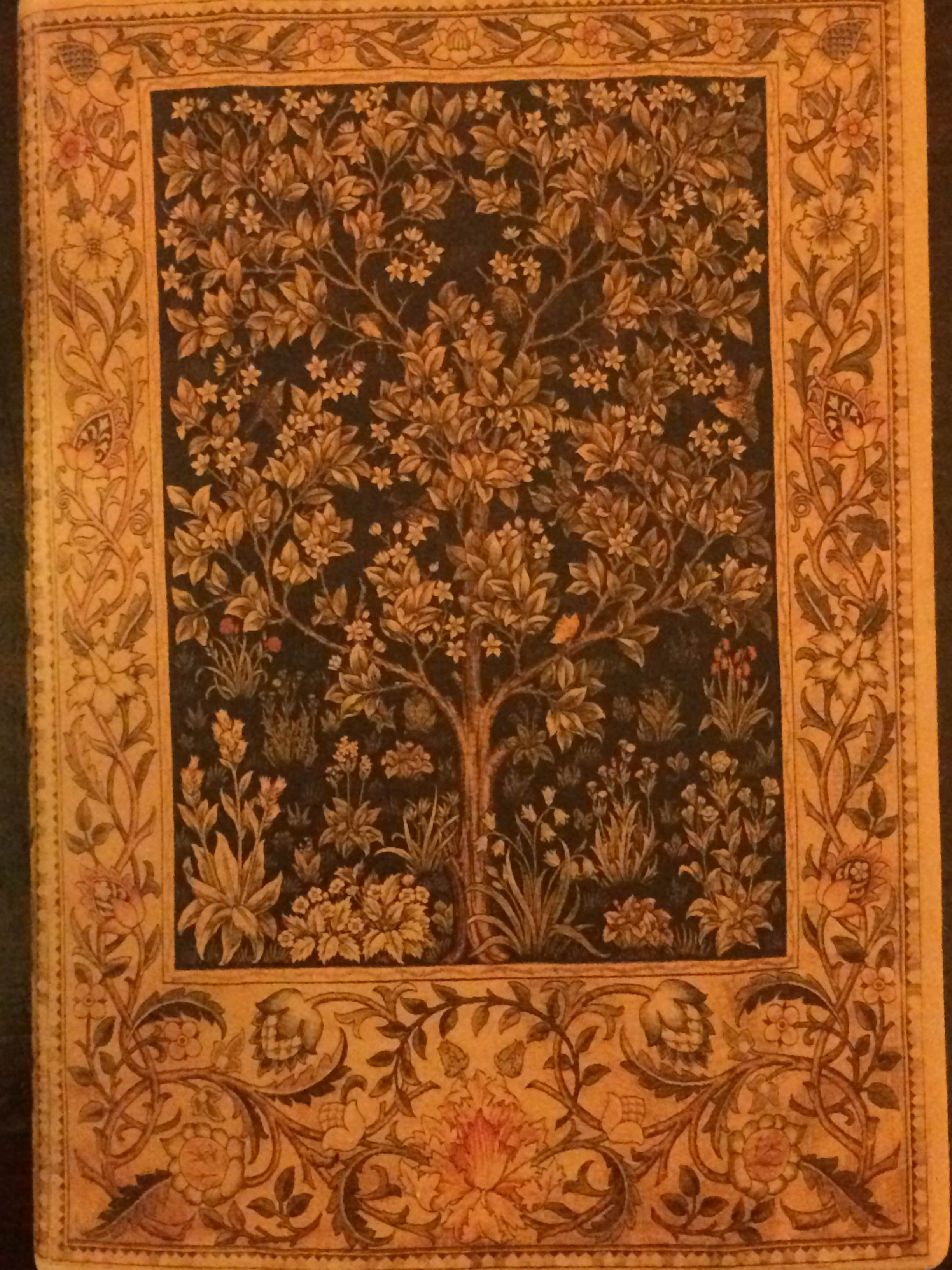
The journals are beautiful and inspiring. The first is leather bound with a detailed tree of life on the front and back covers, and intricate scroll work surrounding them. It was handmade in Italy. How appropriate. When I held it in my hands, it spoke to me of possibility and responsibility. It felt weighty, yet full of potential.

leather journal

The second is hardbound and a reproduction of a journal titled The Rubdiyat of Omar Kkayydm which was created by Francis Sangorski in 1911. The original was encrusted with jewels. It went down with the Titanic in 1912. This exquisite journal spoke of familiarity and confidence. It would be a place where I could easily write.

hardback journal

My lovely pen offered articulate elegance, if I can learn to use it properly. So far, this has turned out to be a more complex task, on all levels, than I anticipated.

Pen

Sabbaticals are about retooling, about visioning possibilities, and about new beginnings. My trip to Florence is the same. This is an interesting moment in my life. My daughter finishes her undergraduate studies in psychology and communication in December. My son is positioning himself for management in a job he loves. I have accomplished everything I have set for myself to this point. I look to the future and delight in the opportunity to consider possibilities for the next phase of my life. This time is for me. How often do we take the chance to sit with the possibilities in a glorious, inspiring place? I know I have never done anything quite like this. I have the gift of time to ponder what will give me joy, fulfillment, purpose. I have the time to reflect on what has given me these things in the past. The answers, in fact, the questions, are not yet clear. I cherish the time to vision, to consider, to contemplate. I look forward to sharing this adventure with you, dear reader.